

Sorting through email marketing options can leave many small business owners feeling stuck. Growing your customer base means more than sending out generic promotions. An effective newsletter gives you a direct line to engaged subscribers, letting you share valuable information while keeping your business visible. This guide shows how applying core principles of targeted, high-quality newsletters can automate engagement and help convert more leads into loyal customers.
Table of Contents
- Defining Email Newsletters And Core Principles
- Types Of Newsletters For Small Business
- Setting Up Your First Newsletter Campaign
- Automating Emails For Consistent Engagement
- Common Pitfalls And Compliance Requirements
Key Takeaways
| Point | Details |
|---|---|
| Email Newsletters Enhance Engagement | By delivering valuable content and building relationships, newsletters serve as strategic tools for business growth. |
| Know Your Audience | Understanding subscriber preferences is crucial for creating targeted and resonant content. |
| Automation Improves Consistency | Email automation allows for personalized communication based on subscriber behavior, enhancing engagement. |
| Avoid Common Pitfalls | Ensure compliance with regulations and maintain engaging content to build trust and minimize risks. |
Defining Email Newsletters And Core Principles
An email newsletter is a targeted digital communication sent regularly to subscribers, designed to deliver valuable content, build relationships, and ultimately drive business growth. These strategic messages go far beyond simple promotional blasts, serving as a direct channel between businesses and their audience. Modern email newsletters represent a sophisticated marketing tool that enables personalized, permission-based communication.
Effective newsletters are built on several core principles. Email marketing success requires understanding audience preferences and delivering content that resonates. Key components include:
- Consistent scheduling
- Targeted, valuable content
- Professional design
- Clear calls to action
- Measurable engagement metrics
The primary goal of an email newsletter transcends mere information sharing. It represents a strategic approach to nurturing customer relationships, establishing thought leadership, and creating a reliable touchpoint that keeps your brand top of mind. Successful newsletters strike a delicate balance between providing genuine value and subtly promoting your business offerings.
Pro tip: Segment your email list based on subscriber behaviors and interests to dramatically improve engagement and conversion rates.
Types Of Newsletters For Small Business
Small businesses have multiple newsletter strategies to engage their audience and drive growth. Newsletters help target specific audience segments through carefully crafted content approaches. Understanding these distinct types can help entrepreneurs select the most effective communication method for their specific business goals.
The primary newsletter types for small businesses include:
-
Product Update Newsletters
- Highlight new offerings
- Showcase recent improvements
- Provide technical details and benefits
-
Educational Newsletters
- Share industry insights
- Offer professional tips
- Demonstrate thought leadership
-
Promotional Newsletters
- Feature special discounts
- Announce limited-time offers
- Create urgency and drive sales
-
Customer Success Newsletters
- Share client testimonials
- Showcase case studies
- Build trust and credibility
Each newsletter type serves a unique purpose in connecting with potential and existing customers. The key is selecting a format that aligns with your business objectives and resonates with your target audience. Successful newsletters blend informative content with strategic marketing goals, creating a communication channel that feels personal and valuable.
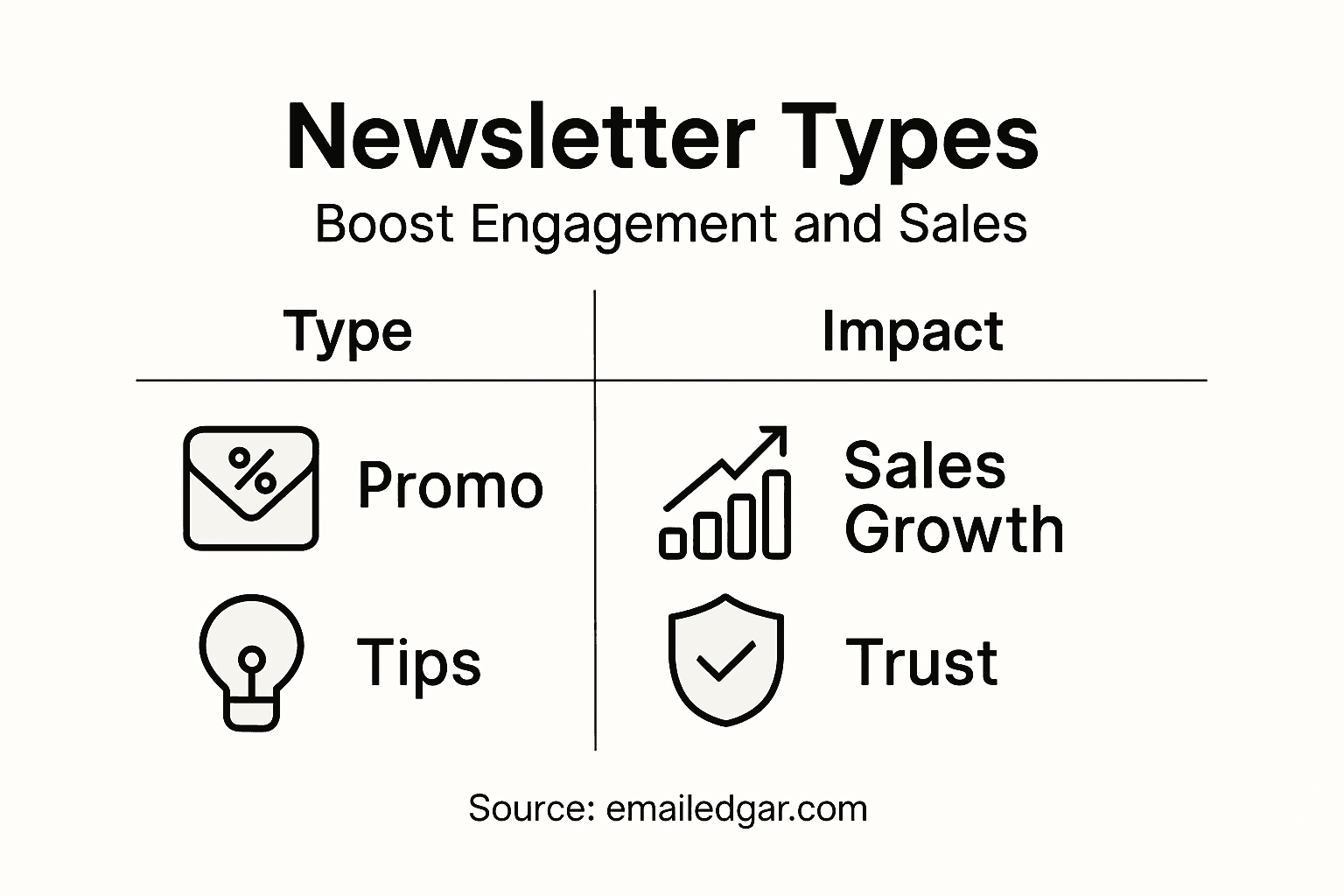
Here’s a comparison of newsletter types and their strategic business benefits:
| Newsletter Type | Main Objective | Ideal Audience | Business Impact |
|---|---|---|---|
| Product Update | Announce new features | Current customers | Drives product adoption |
| Educational | Share industry insights | Prospects & clients | Establishes authority |
| Promotional | Highlight sales & offers | Price-sensitive buyers | Boosts short-term revenue |
| Customer Success | Build trust & credibility | Loyal customers | Encourages repeat business |
Pro tip: Test different newsletter types and track engagement metrics to understand which format generates the most interest and conversions for your specific business model.
Setting Up Your First Newsletter Campaign
Launching your first newsletter campaign requires strategic planning and thoughtful execution. Creating effective newsletters involves multiple critical steps that can significantly impact your marketing success. Understanding these foundational elements will help you build a compelling communication strategy that resonates with your audience.
Key steps for establishing a successful newsletter campaign include:
-
Define Your Audience
- Identify target demographic
- Understand subscriber interests
- Create detailed audience personas
-
Choose an Email Service Provider
- Compare platform features
- Check pricing and scalability
- Ensure robust analytics capabilities
-
Design Your Newsletter
- Select clean, responsive template
- Maintain consistent branding
- Optimize for mobile viewing
-
Develop Compelling Content
- Write engaging subject lines
- Create valuable, concise content
- Include clear calls to action
Successful newsletter campaigns are not about sending emails but creating meaningful connections. Your content should provide genuine value, addressing subscriber needs while subtly promoting your business objectives. Continuous testing and refinement will help you understand what resonates most with your audience.
Below is a summary of key factors to consider when choosing an email service provider for your campaign:
| Factor | Why It Matters | What to Look For |
|---|---|---|
| Scalability | Supports future growth | Flexible subscription tiers |
| Analytics | Informs campaign strategy | Detailed reporting tools |
| Integration | Simplifies workflows | CRM, ecommerce connectors |
| Deliverability | Improves inbox rates | Good sender reputation |
Pro tip: Start with a small, engaged subscriber list and focus on delivering high-quality content before expanding your newsletter reach.
Automating Emails For Consistent Engagement
Email marketing automation transforms how businesses communicate with their audience, turning routine communications into strategic engagement tools. Strategic email automation nurtures leads automatically by creating intelligent, responsive communication sequences that adapt to subscriber behavior and preferences.
Key automation strategies for consistent engagement include:
-
Trigger-Based Emails
- Welcome series for new subscribers
- Abandoned cart reminders
- Post-purchase follow-ups
- Re-engagement campaigns
-
Segmentation Techniques
- Categorize subscribers by behavior
- Personalize content delivery
- Match messaging to subscriber interests
-
Performance Tracking
- Monitor open rates
- Track click-through percentages
- Analyze conversion metrics
- Continuously refine automation workflows
Successful email automation goes beyond scheduling messages. It requires understanding subscriber psychology, creating meaningful interactions, and developing a systematic approach that feels personal and responsive. The goal is to make automated emails feel like a conversation, not a broadcast.

Pro tip: Start with 3-5 core automation workflows and progressively expand complexity as you gain insights from subscriber interactions.
Common Pitfalls And Compliance Requirements
Email newsletters demand strategic attention to avoid potential legal and marketing missteps. Email marketing requires careful compliance with regulations to protect both businesses and subscribers from potential risks.
Common pitfalls that can undermine your email marketing efforts include:
-
Content-Related Issues
- Generic, unengaging subject lines
- Poorly written or unprofessional messaging
- Overwhelming readers with too many links
- Irrelevant or inconsistent content
-
Legal Compliance Challenges
- Incorrect header information
- Deceptive subject lines
- Missing physical business address
- Inadequate unsubscribe mechanisms
-
Technical Red Flags
- Inconsistent sending frequencies
- Neglecting email list hygiene
- Failing to segment subscriber lists
- Ignoring engagement metrics
Navigating the complex landscape of email marketing requires a multifaceted approach. Successful newsletters balance engaging content with strict adherence to legal requirements, ensuring that each communication builds trust and provides genuine value to subscribers.
Pro tip: Create a comprehensive compliance checklist that you review before sending each newsletter to minimize legal and marketing risks.
Transform Your Email Newsletter Into a Silent Sales Machine
The article highlights the challenge of turning email newsletters from just information-sharing tools into powerful engines that drive real sales and nurture customer relationships reliably. Many businesses struggle with consistency, content personalization, and automating their campaigns in ways that genuinely engage their audience. If you want to overcome these hurdles and master core concepts like segmentation, automation workflows, and compelling calls to action, you need a solution designed to make email marketing effortless and effective.
At emailedgar.com, we specialize in helping businesses like yours build and maintain high-performing email lists that convert subscribers into loyal customers. Our platform focuses on creating automated, consistent email campaigns that work 24/7 as your silent sales force. With proven strategies based on the principles discussed in the article, you can confidently launch your first newsletter campaign, avoid common pitfalls, and watch your engagement and revenue grow.
Stop sending generic emails that get ignored. Visit emailedgar.com today to access expert coaching, free resources, and powerful automation tools that simplify the entire process. Take the first step to turning your email newsletter into a dependable, revenue-generating asset now.
Frequently Asked Questions
What is the purpose of an email newsletter?
An email newsletter serves as a targeted digital communication tool that delivers valuable content to subscribers, builds relationships, and drives business growth.
What are the key components of an effective newsletter?
An effective newsletter should have consistent scheduling, targeted and valuable content, professional design, clear calls to action, and measurable engagement metrics.
How can I improve engagement rates for my newsletter?
Segment your email list based on subscriber behaviors and interests. This personalization helps deliver relevant content and can significantly enhance engagement and conversion rates.
What are some common types of newsletters for small businesses?
Small businesses typically use product update newsletters, educational newsletters, promotional newsletters, and customer success newsletters, each serving a distinct purpose for audience engagement.