

Most American online shoppers react to personalized emails with a purchase, proving how crucial strategic email marketing has become for e-commerce sales. For small business owners worldwide, automating email campaigns is no longer a luxury but a must to deliver timely, relevant offers and build customer relationships. Discover exactly how turning email into a sales tool can simplify your workflow, increase engagement, and drive consistent revenue with less effort.
Table of Contents
- Defining Email as a Sales Tool
- Types of Email Marketing for Sales Growth
- How Automated Campaigns Drive Revenue 24/7
- Building and Leveraging Your Email List
- Common Mistakes and How to Avoid Them
Key Takeaways
| Point | Details |
|---|---|
| Email Marketing Is Essential | Leverage email as a strategic sales tool to connect with customers directly through targeted communication. |
| Segment Your Audience | Use advanced segmentation techniques to deliver personalized content, improving engagement and conversion rates. |
| Automate for Efficiency | Implement automated email campaigns to maintain constant engagement and capitalize on customer behavior without manual intervention. |
| Avoid Common Pitfalls | Prevent poor list segmentation and frequency mismanagement by tracking metrics and regularly refining your communication strategy. |
Defining Email as a Sales Tool
Email marketing represents a powerful digital strategy that transforms electronic communication into a strategic sales mechanism for e-commerce businesses. At its core, digital marketing communication enables companies to connect directly with potential and existing customers through targeted electronic messages.
Unlike traditional marketing channels, email provides a unique opportunity for personalized, automated communication that can nurture customer relationships and drive sales. Email sales tools leverage sophisticated segmentation techniques to deliver precisely tailored content at specific stages of the customer journey. By understanding individual customer preferences and behaviors, businesses can craft messages that resonate personally and increase conversion potential.
The strategic approach to email as a sales tool involves more than sending random promotional messages. Modern email marketing integrates targeted commercial messaging with data-driven insights, allowing businesses to segment audiences, track engagement metrics, and continuously refine their communication strategy. This dynamic approach transforms email from a simple communication channel into an intelligent sales platform that adapts and responds to customer interactions.
Pro tip: Create email segments based on customer purchase history, browsing behavior, and engagement levels to dramatically improve your targeted messaging precision and sales conversion rates.
Types of Email Marketing for Sales Growth
Email marketing offers a diverse array of strategic approaches designed to drive sales and engage customers effectively. Promotional strategies encompass multiple email types that target different stages of the customer journey, each serving a unique purpose in generating revenue for e-commerce businesses.
The primary types of email marketing for sales growth include promotional emails, newsletters, transactional emails, and behavioral-triggered campaigns. Promotional emails directly showcase products, offer discounts, and create immediate sales opportunities. Newsletters provide ongoing value through curated content, building brand loyalty and keeping customers informed about new offerings. Transactional emails, such as order confirmations and shipping notifications, represent critical touchpoints that can include additional product recommendations.
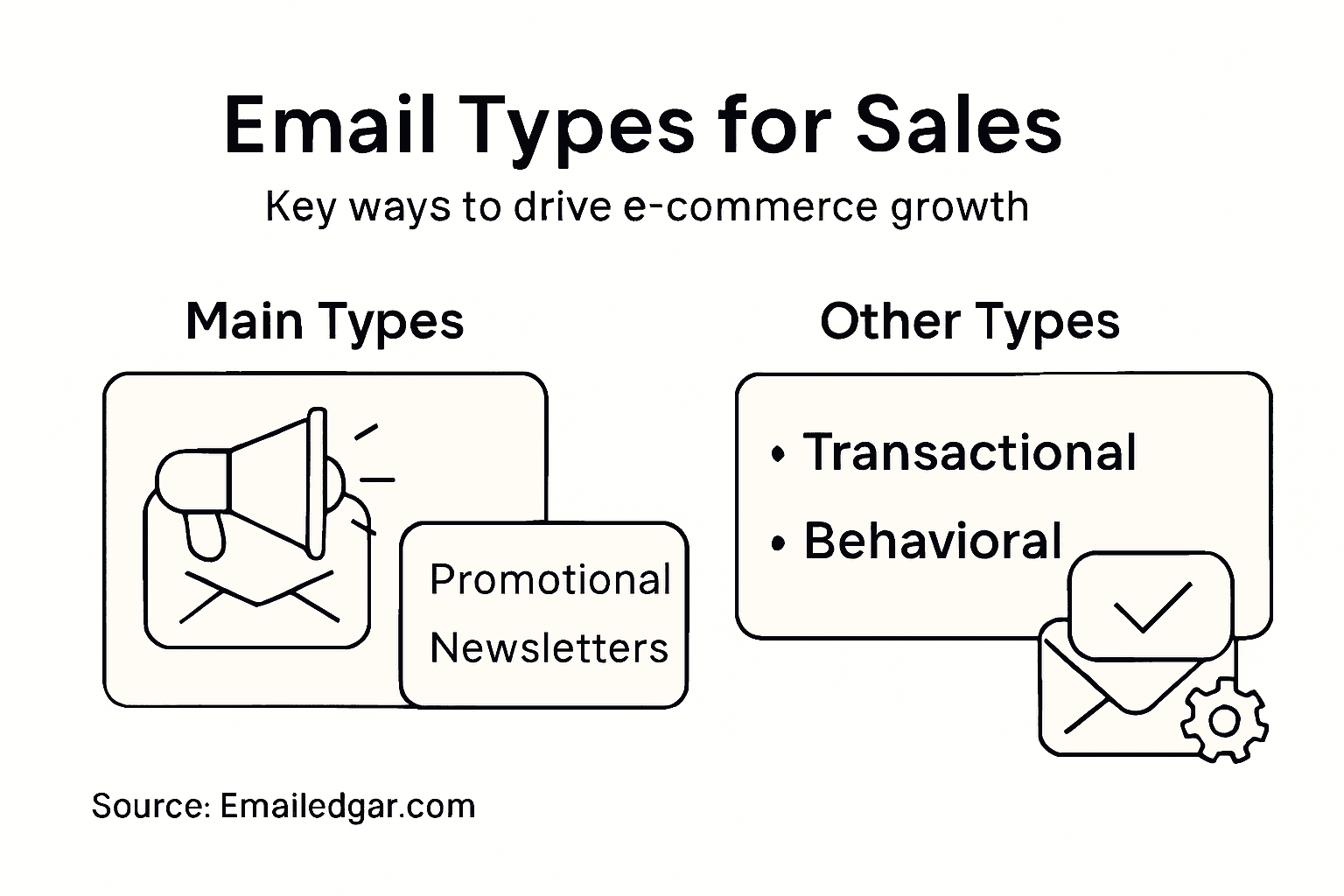
Behavioral-triggered campaigns represent the most sophisticated email marketing approach, automatically responding to specific customer actions. Cart abandonment reminders, browse abandonment emails, and post-purchase follow-ups are powerful techniques that re-engage customers precisely when they are most likely to make a purchase. These targeted messages can dramatically increase conversion rates by addressing customer intentions and potential objections in real-time.
Pro tip: Implement a segmented email strategy that combines different email types, tracking customer interactions to create increasingly personalized and timely marketing messages.
Here’s a summary of key email marketing types and their unique contributions to e-commerce sales:
| Email Type | Main Objective | Engagement Level | Typical Business Impact |
|---|---|---|---|
| Promotional Emails | Drive immediate sales | High (short-term) | Boost short-term revenue |
| Newsletters | Build brand loyalty | Moderate (ongoing) | Increase customer retention |
| Transactional Emails | Provide order updates | High (per transaction) | Promote repeat purchases |
| Behavioral-Triggered Campaigns | Re-engage customers | Very high (timely) | Recover lost sales, improve ROI |
How Automated Campaigns Drive Revenue 24/7
Automated email campaigns transform traditional marketing by creating a continuous sales mechanism that operates independently of human intervention. Trigger-based workflows enable businesses to engage customers precisely when they are most receptive, generating consistent revenue streams around the clock.
These sophisticated campaigns leverage customer data and behavioral insights to deliver personalized messages automatically. Key automated campaign types include welcome series for new subscribers, cart abandonment reminders, post-purchase follow-ups, and re-engagement sequences for inactive customers. Each campaign is strategically designed to move customers through the sales funnel with minimal manual effort, ensuring that potential sales opportunities are never missed.

The power of automated campaigns lies in their ability to create hyper-targeted, timely interactions. By analyzing customer behaviors such as website visits, purchase history, and engagement patterns, these campaigns can trigger specific email sequences that feel individualized and relevant. This approach not only increases the likelihood of conversion but also builds long-term customer relationships by demonstrating an understanding of each customer’s unique needs and preferences.
Pro tip: Map out your customer journey and create automated email sequences that correspond to each stage, ensuring seamless and personalized communication that feels natural and responsive.
Building and Leveraging Your Email List
Building a robust email list is the foundation of successful e-commerce marketing, transforming casual website visitors into potential long-term customers. Effective list-building strategies require a strategic approach that combines compelling lead magnets, targeted opt-in methods, and continuous engagement techniques.
Successful email list development involves multiple sophisticated techniques. Lead magnets such as exclusive discounts, free downloadable resources, or unique content incentivize potential subscribers to share their contact information. Strategically placed opt-in forms on websites, pop-ups triggered by user behavior, and social media lead generation campaigns can dramatically expand your email database. The key is offering genuine value that makes subscribers feel they are gaining something meaningful by joining your list.
Once established, an email list becomes a powerful asset that requires ongoing maintenance and strategic segmentation. Regularly cleansing your list by removing inactive subscribers, creating targeted segments based on customer behaviors, and personalizing content ensures high engagement rates. By understanding different subscriber groups’ preferences and purchasing patterns, businesses can craft laser-focused email campaigns that speak directly to each segment’s unique needs and interests, ultimately driving higher conversion rates and customer loyalty.
Pro tip: Create multiple lead magnets targeting different customer personas to capture a wider range of potential subscribers and increase your email list’s overall quality and diversity.
Below is a comparison of essential list-building strategies and their advantages for e-commerce:
| List-Building Technique | Value Provided | Audience Reach | Lead Quality Impact |
|---|---|---|---|
| Lead Magnets | Attract subscribers fast | Wide if incentive strong | High if relevant offer |
| Opt-in Forms on Website | Capture website visitors | Site-wide/multiple pages | Moderate, depends on placement |
| Social Media Campaigns | Target new demographics | Extended beyond website | Varied, based on targeting |
| Behavior-Based Pop-ups | Engage active site users | Focused, highly relevant | Very high due to personalization |
Common Mistakes and How to Avoid Them
Email marketing success hinges on understanding and avoiding critical pitfalls that can undermine your entire strategy. Common email marketing mistakes can significantly diminish your campaign’s effectiveness and potentially damage your brand’s reputation with potential customers.
One of the most prevalent errors is poor list segmentation, which leads to generic, irrelevant messaging that fails to connect with specific audience segments. Many e-commerce businesses make the mistake of sending identical emails to their entire subscriber base, ignoring individual customer preferences, purchase histories, and engagement levels. This one-size-fits-all approach results in lower open rates, reduced click-throughs, and ultimately, diminished sales potential. Effective segmentation involves creating targeted groups based on detailed criteria such as demographic information, past purchasing behavior, browsing history, and specific interests.
Another critical mistake is frequency mismanagement, which includes both under-communicating and over-emailing. Subscribers quickly become frustrated with excessive emails that flood their inbox, leading to high unsubscribe rates. Conversely, infrequent communication can cause subscribers to forget about your brand. The key is finding a delicate balance that maintains consistent engagement without overwhelming your audience. This requires carefully tracking email performance metrics, monitoring subscriber feedback, and being willing to adjust your communication strategy based on real-world response.
Pro tip: Implement a quarterly email list audit to remove inactive subscribers, refine your segmentation strategy, and ensure your email communications remain razor-sharp and highly relevant.
Unlock the Power of Email as Your Silent Sales Machine
Are you struggling to turn your email list into a reliable source of consistent sales? This article highlights key challenges like poor segmentation, lack of automation, and missed opportunities to engage customers at the right time. At emailedgar.com, we understand that building and maintaining a targeted email list is crucial to transforming your email marketing efforts into a 24/7 revenue generator using automated, personalized campaigns.
Imagine turning every subscriber into a loyal buyer by leveraging automated workflows tailored to customer behavior. Our platform offers proven strategies and hands-on coaching to help you avoid common pitfalls, increase open rates, and boost conversions through highly relevant messaging. Whether you want to launch welcome sequences, cart abandonment reminders, or behavior-triggered campaigns, emailedgar.com is your trusted partner.
Ready to stop wasting potential sales with generic emails? Visit emailedgar.com to explore expert resources and start building automated sales funnels today. Discover how you can craft personalized email journeys that work silently in the background to grow your e-commerce business, increase engagement, and maximize revenue. Don’t wait—your most valuable sales tool is waiting.
Frequently Asked Questions
What is email marketing as a sales tool?
Email marketing as a sales tool involves using targeted electronic messages to connect directly with potential and existing customers, driving engagement and sales for e-commerce businesses.
What are the primary types of email marketing used for sales growth?
The primary types of email marketing for sales growth include promotional emails, newsletters, transactional emails, and behavioral-triggered campaigns, each serving distinct purposes in the customer journey.
How can automated campaigns enhance revenue?
Automated email campaigns use customer data to trigger timely, personalized messages that engage customers at critical moments, generating consistent revenue without requiring manual involvement.
What are effective strategies for building an email list?
Effective email list-building strategies include using lead magnets, strategically placed opt-in forms, social media campaigns, and behavior-based pop-ups to attract and engage potential subscribers.