

Sending sales emails that end up unread is a frustration shared by every Canadian and American business owner. Writing messages that truly resonate demands way more than a generic template. When you align your email strategy with a clearly defined audience and a bold value proposition, your campaigns transform into focused conversations and drive stronger responses. This guide reveals how to create targeted, persuasive emails that speak directly to your ideal reader and inspire measurable action.
Table of Contents
- Step 1: Define Your Target Audience And Email Goal
- Step 2: Build A Compelling Subject Line
- Step 3: Craft A Persuasive Message And Value Proposition
- Step 4: Optimize Your Call-To-Action For Responses
- Step 5: Review And Test Your Sales Email For Results
Quick Summary
| Key Takeaway | Explanation |
|---|---|
| 1. Define target audience and goal | Clearly identify who your ideal customer is and what action you want them to take with your email. |
| 2. Craft a compelling subject line | Use attention-grabbing headlines that promise value and match the content of your email to encourage opens. |
| 3. Present a persuasive value proposition | Focus on specific benefits to the reader, ensuring they understand what’s in it for them right away. |
| 4. Optimize call-to-action for clarity | Include one clear action for the reader to take, using strong, actionable language that resonates with their needs. |
| 5. Test and review before sending | Thoroughly check for errors, test across devices, and conduct A/B testing to improve future campaigns based on audience engagement. |
Step 1: Define your target audience and email goal
Before you write a single word of your sales email, you need to know who you’re writing to and what you want them to do. This sounds obvious, but most small business owners skip this step entirely. They craft emails assuming everyone is their customer, then wonder why conversions tank. Defining your target audience and email goal transforms your sales emails from generic broadcasts into focused conversations that actually resonate with the right people.
Start by identifying who your ideal customer really is. Demographics, behaviors, and motivations form the foundation of this understanding. Ask yourself specific questions. Who experiences the exact problem your product solves? Are they business owners, managers, or individual contributors? What’s their income level, industry, and company size? What keeps them up at night? Once you’ve mapped out these details, you’ve got a clear picture of who should open your email. This specificity matters enormously because your messaging, language, and offers will shift dramatically based on who’s receiving them. A manager struggling to reduce team turnover needs completely different messaging than a solopreneur trying to streamline workflows.
Next, define your email goal with laser precision. Don’t just say “increase sales.” That’s too vague. Your goal might be to get a meeting scheduled, encourage a free trial signup, move someone from prospect to customer, or re-engage inactive buyers. Every email serves one primary objective. When you write email copy that converts and engages, you’re guiding the reader toward a specific action. If you’re asking someone to book a call, your copy emphasizes different benefits than if you’re trying to get them to download a resource. The clearer your goal, the more focused your email becomes, and the higher your conversion rates climb.
Pro tip: Write down your target audience description and email goal as single sentences before drafting anything. This forces clarity and keeps you on track when you’re tempted to add extra offers or rambling explanations.
Here’s a summary of ways to define and refine your target audience for effective sales emails:
| Targeting Method | Example | Business Value |
|---|---|---|
| Demographic profile | Industry, company size, income | Enables tailored messaging |
| Behavioral traits | Purchase history, engagement | Drives relevant offers |
| Motivation analysis | Pain points, goals | Increases conversion rates |
| Role-specific needs | Manager vs. contributor | Improves message resonance |
Step 2: Build a compelling subject line
Your subject line is the gatekeeper between your email and the trash folder. If it does not grab attention, nothing else matters. Readers decide whether to open your email in about two seconds, often before they even see your name or preview text. Building a compelling subject line means crafting something that promises value, sparks curiosity, or speaks directly to your reader’s biggest problem without being vague or misleading.
Start by understanding what makes a subject line work. Attention-grabbing elements and clear value propositions align with your email’s core message and drive opens. Avoid being too cute or clever. Your reader needs to immediately understand what benefit they will get by opening. Instead of “Check this out,” try “Three ways you are losing customers to competitors.” That second version makes a specific promise tied to a real business pain point. You could also use curiosity strategically, like “The one metric your team is probably ignoring,” but pair it with relevance. A curious subject line fails if it has nothing to do with what the reader actually cares about.
Personalization matters more than you might think. Adding the reader’s first name increases opens, but only when done naturally. Avoid feeling like a mass email template. If you are writing to a manager at a software company, reference something about their industry or role. “Sarah, here’s how SaaS teams like yours cut onboarding time in half” hits differently than a generic opener. Test different approaches by running A/B tests on subject lines. Send half your list version A, half version B, and see which gets better opens. After a few weeks of testing, you will know exactly what resonates with your specific audience.
Your subject line should also match the tone and promise of the email body. If your subject line sounds urgent and exciting, but your email is a slow, formal pitch, readers feel deceived and trust erodes. Keep the promise simple and deliverable. The goal is to get the open, sure, but the real win happens when the email content matches what the subject line suggested.
Pro tip: Write ten different subject line variations and read them aloud before choosing one. What sounds natural when spoken usually works better than what looks polished on screen.
Step 3: Craft a persuasive message and value proposition
Now that you know who you’re writing to and have their attention through your subject line, your message needs to deliver on that promise immediately. This is where most sales emails fail. The writer launches into features, company history, or generic benefits when the reader is still asking one simple question: what is in it for me? Crafting a persuasive message means making your value proposition the hero of your email, not burying it in paragraph three.
Start by articulating your unique benefits and what customers gain from your solution. This needs to be specific to the reader’s situation. Instead of saying “our software saves time,” say “our software cuts your monthly reporting time from eight hours to thirty minutes.” That number matters. It makes the benefit concrete and believable. Your value proposition should answer three things: what problem you solve, how you solve it differently than competitors, and why the reader should care right now. Avoid industry jargon that confuses rather than clarifies. Your reader is busy. They need to understand your message in seconds, not minutes.
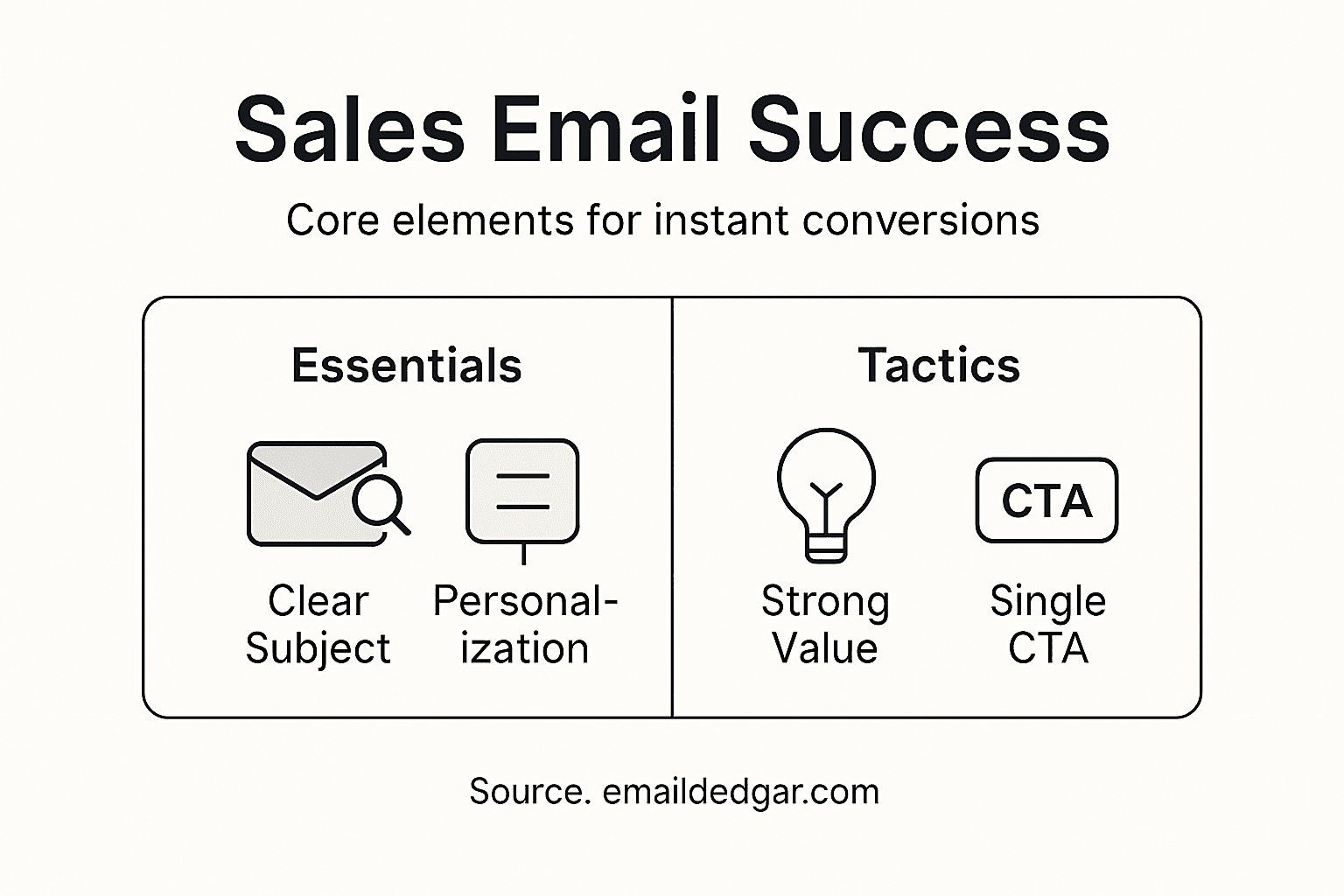
Layering in emotional connection transforms a sales email from transactional to compelling. Persuasive emails address pain points and build trust through social proof. Share a customer testimonial or result that shows someone similar to your reader achieved real outcomes. A manager reading about how another manager increased team productivity resonates more than an abstract statistic. You can also tap into curiosity or mild urgency without being manipulative. “Most companies your size are missing this one opportunity” creates a gentle push without feeling forced. Keep your message concise though. Every sentence should either reinforce your value proposition or move the reader closer to your desired action. Remove anything that feels like filler.
End your message by making the next step obvious and easy. Do not ask the reader to do research or figure out what happens next. Tell them exactly what you want them to do and why it matters to them specifically.
Pro tip: Before sending, read your email as if you received it cold from a stranger. Does it answer “what is in it for me?” in the first three sentences? If not, cut or rewrite what comes before that point.
Step 4: Optimize your call-to-action for responses
Your call-to-action is the moment of truth. Everything before it builds to this point, and everything after it determines whether you get a response. A weak or confusing CTA wastes all the work you did in the previous steps. Optimizing your call-to-action means making it impossible for readers to miss, impossible to misunderstand, and impossible to ignore.

Start with a single, crystal-clear action. Effective CTAs are clear, concise, and prominently placed to guide recipients toward the desired outcome. Do not ask your reader to choose between multiple options. That creates decision paralysis. One CTA per email. If you want them to book a call, every element of your email points to that one button or link. If your secondary goal is to download a resource, save that for a follow-up email. The language matters too. Instead of generic “Submit” or “Learn More,” use action verbs that speak to the specific outcome. “Schedule your free consultation” beats “Click here.” “See how three companies cut costs by 40 percent” works better than “View case studies.” Your reader should know exactly what happens when they click and why it benefits them.
Placement and design amplify your CTA’s effectiveness. Put your primary CTA above the fold so readers see it without scrolling. Use contrasting colors that stand out against your email background. Make buttons large enough to tap easily on mobile devices. CTAs that assume the sale and use persuasive language encourage prompt action and higher engagement rates. Language like “Get started today” or “Claim your spot” creates forward momentum. Avoid timid phrasing such as “if you are interested” or “feel free to reach out.” Those undermine your confidence in the value you offer.
Test different CTA variations to find what resonates with your specific audience. A/B test the button text, color, placement, or surrounding copy. Track which versions generate the most clicks and responses. What works for a B2B software company might not work for a service provider. Your data will tell you the truth about what motivates your audience to act.
Pro tip: Place your CTA button or link on its own line with white space around it, making it the visual focal point of your email. Readers’ eyes should land on it naturally without having to search.
Step 5: Review and test your sales email for results
Before you hit send on your email campaign, you need to review it thoroughly and test it across devices and email clients. This is not busywork. A typo, broken link, or email that renders strangely on mobile can tank your conversion rates instantly. More importantly, testing gives you data about what actually works with your audience, which means every campaign gets better than the last one.
Start with a manual review. Read your email out loud to catch awkward phrasing and typos your eyes might skip. Check that all links work and point to the correct destinations. Test your email on multiple devices and email clients because what looks perfect in Gmail might look broken in Outlook. Most small business owners send emails from their own inbox, so send yourself a test copy and check it on your phone, tablet, and desktop. Verify that images load, buttons display correctly, and your CTA stands out. Beyond the mechanics, review your messaging one more time. Does your subject line match the email content? Does your value proposition appear early? Is your CTA clear and easy to find? Testing email effectiveness across customer segments and channels significantly improves sales performance and helps maximize your campaign ROI.
Once you have reviewed the basics, implement A/B testing to find what resonates with your specific audience. Split your email list and send different versions to different groups. Test one variable at a time, whether that is subject line, opening line, CTA button text, or sending time. Measuring open rates and conversion rates helps assess campaign effectiveness and informs improvements for future sends. Track which version performs better, then use that winning element in your next campaign. This feedback loop compounds over time. After five campaigns, you will know exactly what your audience responds to. After ten campaigns, you will have converted significantly more clients than someone who never tests. Do not aim for perfection on your first attempt. Aim for learning and iteration.
Compare key strategies for A/B testing sales emails effectively:
| Testing Area | Common Variation | Impact on Results |
|---|---|---|
| Subject line | Curiosity vs. benefit | Affects open rates |
| CTA button text | “Book a call” vs. “Get started” | Influences click-throughs |
| Send time | Morning vs. afternoon | Changes engagement levels |
| Email layout | Single column vs. multi-column | Alters readability and action |
Pro tip: Send your email to three to five colleagues or friends who match your target audience profile and ask for feedback before the full send. Fresh eyes catch confusing sections and spot broken links you might have missed.
Unlock the Power of Sales Emails That Truly Convert
The challenge of writing sales emails that instantly engage your audience and drive action is real. Many business owners struggle to define their target audience, craft the right message, and create compelling calls to action — all essential steps to boost conversions. This article highlights how knowing your audience, delivering laser-focused value propositions, and testing your emails can dramatically change your results. If you find yourself overwhelmed by crafting emails that avoid generic language or fail to spark interest, you are not alone.
Imagine having a silent sales machine working around the clock to nurture your leads, engage your customers, and increase revenue automatically. At emailedgar.com, we specialize in helping businesses automate and master email marketing so you don’t miss out on valuable opportunities. From building targeted email lists to expertly designing persuasive campaigns with clear, impactful calls to action, our platform empowers you to turn the principles you learned in this guide into results that matter.
Don’t let poorly structured emails hold your sales back. Take control and transform your approach by exploring how emailedgar.com can help you create effective, personalized email sequences. Ready to get started with proven strategies and tools today?
Explore how to write email copy that converts
Learn how to engage your audience and boost conversions
Visit emailedgar.com and start building your email marketing success story now.
Frequently Asked Questions
How do I define my target audience for sales emails?
To define your target audience, identify specific demographics, behaviors, and motivations of those who experience the problem your product solves. Create a detailed profile including roles, income levels, and pain points, which will help tailor your messaging to resonate with them.
What should my email goal be when writing sales emails?
Your email goal should be specific and focused, such as getting a meeting scheduled or encouraging a free trial signup. Define this goal clearly to guide your writing and ensure every element of the email supports it for higher conversion rates.
How can I create a compelling subject line for my sales email?
To create a compelling subject line, focus on delivering value and addressing the recipient’s main concerns. Use clear language that makes a specific promise or sparks curiosity, ensuring it aligns with the email’s content for consistency.
What elements should I include in a persuasive message for my sales email?
A persuasive message should highlight your unique benefits and value proposition clearly, addressing the recipient’s pain points. Include concrete examples and emotional connections, and ensure your message is concise and easy to understand from the outset.
How do I optimize my call-to-action in sales emails?
To optimize your call-to-action, make it clear, concise, and easy to find, focusing on a single action you want the reader to take. Use direct language like “Schedule your free consultation” and place the CTA prominently within your email layout to drive responses.
What steps should I take to review and test my sales email before sending?
Before sending, thoroughly review your email for typos, broken links, and formatting issues across different devices and email clients. Always conduct A/B testing on elements like subject lines and CTAs to gather data on what works best with your audience.