

Most American businesses miss out on lasting revenue because their emails fail to speak directly to their customers’ real needs. In a world where personalized engagement drives repeat sales, knowing exactly who you want to reach and what you want to accomplish is essential. This guide takes you step by step through building smarter, automated email workflows so you can connect with the right audience, increase loyalty, and turn every message into a sales opportunity.
Table of Contents
- Step 1: Define Your Target Audience And Email Goals
- Step 2: Segment Your Email List For Personalized Messaging
- Step 3: Develop Automated Email Sequences
- Step 4: Integrate Promotional And Educational Content
- Step 5: Test And Optimize Engagement Metrics
Quick Summary
| Key Insight | Explanation |
|---|---|
| 1. Understand Your Target Audience | Analyze customer behaviors and preferences to create effective communication. Personalization increases engagement. |
| 2. Segment Your Email List | Break your audience into specific groups for tailored messages based on their interactions and preferences. |
| 3. Automate Email Sequences | Design automated messages that guide subscribers through their journey, optimizing engagement at critical points. |
| 4. Balance Promotional and Educational Content | Use an 80/20 ratio of value to promotion to maintain engagement and establish trust with subscribers. |
| 5. Measure and Optimize Performance | Regularly track key metrics to refine strategies. Use A/B testing to improve engagement based on real data. |
Step 1: Define your target audience and email goals
Creating a successful email engagement workflow starts with precision targeting and crystal clear objectives. Your ability to identify specific audience characteristics determines how effectively you will connect and convert potential customers.
Begin by developing a comprehensive audience profile that goes beyond basic demographics. Analyze your existing customer base and research their core behaviors, preferences, and pain points. Consider factors like age, income level, professional background, online purchasing habits, and specific challenges your product or service solves. This granular understanding allows you to craft personalized email content that resonates deeply with your ideal customers.
Next, establish specific email campaign goals that align with your broader business objectives. Are you seeking to drive immediate sales, nurture long term customer relationships, introduce new product lines, or re-engage dormant subscribers? Each goal requires a distinct strategic approach. Email marketing strategies work best when your messaging precisely matches your desired outcome and your audience’s current stage in the customer journey.
Pro tip: Create a detailed customer persona document that includes not just demographic data but emotional triggers and specific communication preferences to supercharge your email targeting strategy.
Step 2: Segment your email list for personalized messaging
Email list segmentation is a powerful strategy that transforms generic marketing into highly targeted communication. Your goal is to divide consumers into homogeneous groups that allow for precision messaging tailored to specific audience characteristics.

Start by analyzing your existing customer data to create meaningful segments. Break down your email list using criteria like purchase history, engagement levels, geographic location, demographic information, and behavioral patterns. For instance, you might create segments such as new subscribers, frequent buyers, occasional purchasers, or customers who have not made a purchase in the last six months. This approach enables you to craft targeted email messages that speak directly to each group’s unique needs and interests.
Implement your segmentation strategy by using email marketing tools that allow dynamic list management. These tools can automatically categorize subscribers based on their interactions with previous emails, website behavior, or specific actions they take. By continuously refining your segments, you create more personalized communication that increases engagement, builds trust, and ultimately drives higher conversion rates.
Pro tip: Review and update your email list segments quarterly to ensure your targeting remains accurate and responsive to changing customer behaviors and preferences.
Here’s a comparison of common email list segmentation criteria and their marketing benefits:
| Segmentation Criteria | Description | Business Impact |
|---|---|---|
| Purchase History | Groups by buying frequency | Targets offers to likely buyers |
| Engagement Level | Based on email interaction rates | Improves relevance and open rates |
| Geographic Location | Regions or countries | Enables local promotions |
| Behavioral Patterns | Website and browsing activity | Personalizes recommendations |
Step 3: Develop automated email sequences
Automated email sequences transform your marketing strategy from manual outreach to a sophisticated systematic communication approach. Creating these sequences requires strategic planning to efficiently send emails that engage subscribers at precisely the right moments in their customer journey.
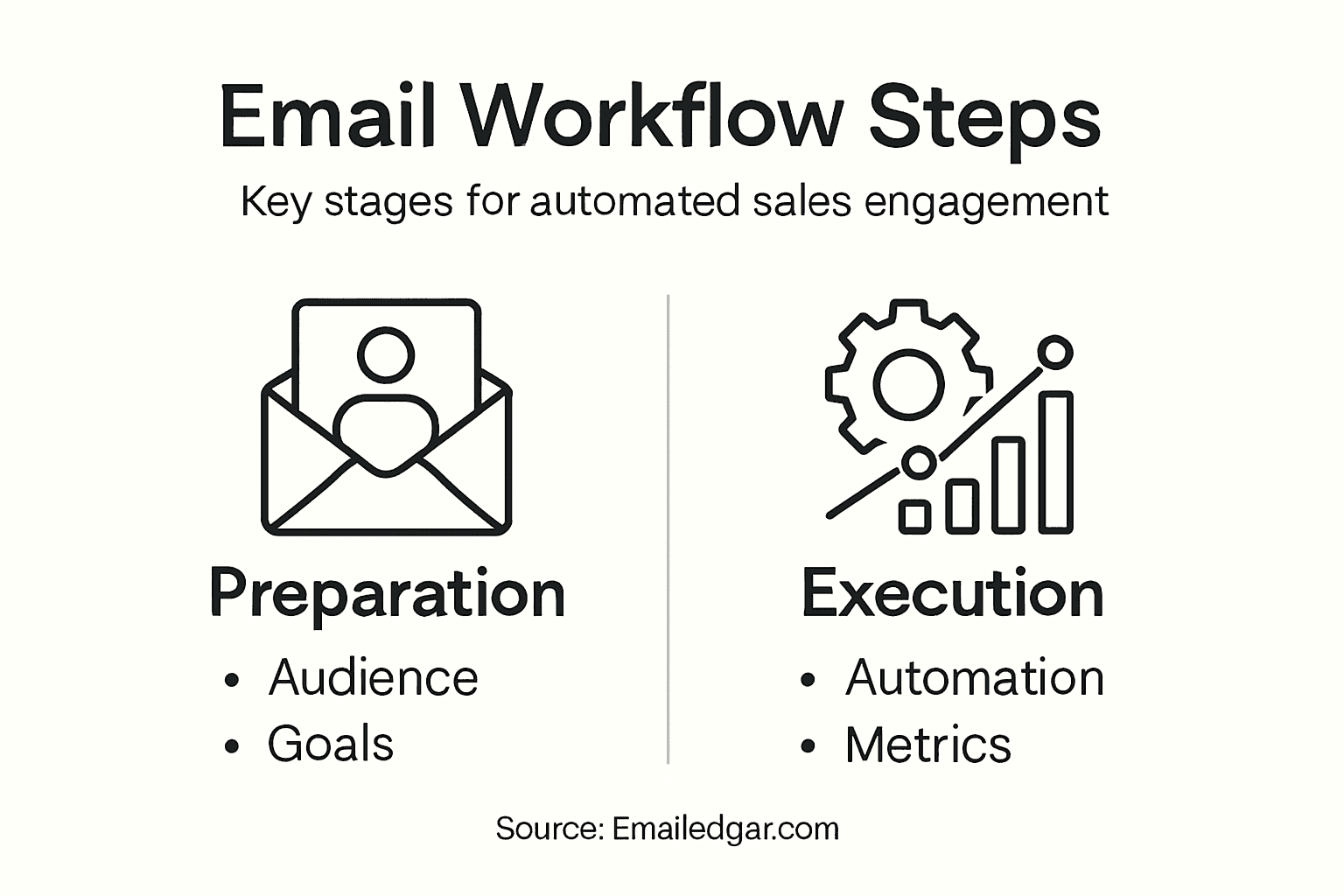
Design your email sequence by mapping out a logical progression of messages that nurture leads and guide them through your sales funnel. Start with a welcome email for new subscribers, followed by educational content, social proof, and targeted offers. Each email should have a specific purpose and flow seamlessly into the next. Use programmatic email construction techniques to personalize content based on subscriber segments, ensuring each message feels tailored and relevant. Consider creating different sequences for various audience segments like new leads, recent purchasers, or long-term customers.
Implement your automated sequence using email marketing platforms that support complex trigger based workflows. Set up conditions that determine when and to whom specific emails are sent based on subscriber actions like email opens, link clicks, or purchase history. This dynamic approach allows your email marketing to respond intelligently to individual subscriber behaviors, creating a more engaging and responsive communication strategy.
Pro tip: Test and refine your email sequences continuously by tracking key metrics like open rates, click through rates, and conversion performance to optimize your automated communication.
Step 4: Integrate promotional and educational content
Successful email marketing requires a strategic balance between promotional offers and valuable educational content. Effective email campaigns blend information and incentives to maintain subscriber engagement and build long term trust.
Design your email content with a clear 80/20 ratio where 80% of your messaging provides genuine value through educational insights, industry trends, helpful tips, or problem solving advice. The remaining 20% can focus on promotional elements like special discounts, new product announcements, or exclusive offers. This approach ensures subscribers view your emails as resources rather than pure sales pitches. Craft educational content that directly relates to your products or services without feeling overtly commercial. For example, a software company might share troubleshooting tips, while an online fitness platform could provide nutrition guidance that subtly highlights their training programs.
Ensure your promotional content feels natural and contextually relevant by tying it directly to the educational material. Marketing strategies that intertwine promotion and education work best when the sales message emerges organically from the valuable information you are sharing. This might mean including a soft product recommendation at the end of an informative article or presenting a limited time offer that directly solves a problem you have just explained.
Pro tip: Create a content calendar that maps out educational topics and promotional opportunities in advance to maintain a consistent and balanced email communication strategy.
Step 5: Test and optimize engagement metrics
Measuring and improving email campaign performance requires a systematic approach to tracking key engagement metrics and performance indicators. Understanding how subscribers interact with your emails provides critical insights that can dramatically enhance your marketing strategy.
Focus on analyzing core metrics that reveal the true effectiveness of your email campaigns. Track open rates to understand how compelling your subject lines are, click through rates to measure content relevance, and conversion rates to determine the ultimate impact on your business goals. Use A/B testing methodologies to experiment with different email elements like subject lines, send times, content layouts, and call to action designs. This data driven approach allows you to make incremental improvements that compound over time, gradually increasing your email engagement and sales performance.
Implement a continuous optimization cycle where you regularly review standardized engagement tracking frameworks to understand subscriber behavior. Set up automated reporting that provides clear visualizations of your key performance indicators. Compare metrics across different subscriber segments to identify which approaches resonate most effectively with specific audience groups. Remember that optimization is an ongoing process requiring consistent attention and willingness to adapt your strategy based on actual subscriber interactions.
Pro tip: Create a monthly dashboard that tracks your key email engagement metrics, allowing you to quickly identify trends and make data informed marketing decisions.
For reference, here are key email engagement metrics and what each reveals about your campaign performance:
| Metric | What It Measures | Business Insight |
|---|---|---|
| Open Rate | Email opens by recipients | Effectiveness of subject lines |
| Click Rate | Clicks on email links | Relevance of email content |
| Conversion Rate | Actions taken (e.g., purchase) | Success in driving desired outcomes |
| Unsubscribe Rate | Number leaving email list | Potential issues with content or frequency |
Unlock the Power of Automated Email Engagement Workflows
If you find it challenging to master the complex steps of defining your audience, segmenting your list, and building automated email sequences that truly convert, you are not alone. Many businesses struggle with keeping their email communication personalized, relevant, and consistent while balancing promotional and educational content. This article highlights key obstacles like maintaining dynamic segments and optimizing engagement metrics that can leave your sales potential untapped.
At emailedgar.com, we understand these challenges because we focus on transforming your email list into a silent sales machine working around the clock. Our platform guides you through building precise customer personas, executing automated sequences tailored to different audience segments, and balancing valuable educational content with promotional messaging that drives real sales growth. Experience strategies that build trust, increase open and click rates, and turn subscribers into loyal customers.
Ready to stop guessing and start automating your email marketing workflow for maximized engagement and sales?
Explore expert coaching and proven email marketing resources at Emailedgar today. Take control of your email campaigns now and watch your sales funnel transform. Learn more about how to build your own automated sequence and segment your lists effectively to boost revenue by visiting our site.
Frequently Asked Questions
How do I define my target audience for email engagement workflows?
To define your target audience, analyze existing customer data and identify key characteristics such as demographics, behaviors, and pain points. Create a comprehensive audience profile to tailor your email content effectively.
What email segmentation strategies should I implement for targeted messaging?
Implement segmentation by analyzing customer data and grouping subscribers based on criteria like purchase history, engagement level, and geographic location. This allows you to send personalized email messages that resonate with each group’s unique needs.
How do I develop effective automated email sequences?
To develop automated email sequences, map out a series of messages that guide subscribers through their customer journey, starting with a welcome email and progressing to targeted content and offers. Use triggers based on subscriber behavior to send relevant emails when it matters most.
What balance should I maintain between promotional and educational content in my emails?
Aim for an 80/20 ratio, where 80% of your email content offers educational insights and 20% contains promotional material. This approach keeps your subscribers engaged while providing value, making them more receptive to your sales pitches.
How can I optimize my email engagement metrics for better performance?
To optimize email engagement, track key metrics such as open rates, click-through rates, and conversion rates. Create a monthly dashboard to identify trends and make data-informed decisions that can improve your overall email marketing strategy.