

Most American small business owners want a simple way to make email marketing work for them without spending hours crafting every message. With over 60 percent of emails now opened on mobile devices, relying on manual sends can leave your business behind. Automation helps keep customers engaged and sales steady, especially when social media reach is unpredictable. This guide breaks down how email marketing builds lasting customer relationships and shows you how automation can save time while delivering results.
Table of Contents
- Defining Email Marketing And Its Core Value
- Types Of Email Campaigns For Small Business
- How Email Automation Drives Results
- Key Advantages Over Social Media Marketing
- Common Email Marketing Challenges And Solutions
Key Takeaways
| Point | Details |
|---|---|
| Email Marketing is a Direct Channel | Email marketing provides businesses with direct communication, allowing for personalized interactions that bypass social media algorithms. |
| Segmentation Enhances Targeting | By segmenting audiences based on behaviors and demographics, small businesses can create tailored messages that improve engagement and conversions. |
| Email Automation Increases Efficiency | Automated email systems allow businesses to send timely, relevant messages without manual intervention, enhancing customer experience and retention. |
| Clear ROI Tracking | Email marketing typically yields a high return on investment, making it an effective and measurable strategy compared to social media. |
Defining Email Marketing and Its Core Value
Email marketing is a powerful digital communication strategy that enables businesses to connect directly with their audience through personalized electronic messaging. At its core, this approach centers around building and nurturing an owned communication channel that provides small businesses unprecedented control over customer interactions. Unlike social media platforms governed by unpredictable algorithms, email marketing offers a strategic communication asset businesses can leverage for targeted outreach.
The fundamental value of email marketing lies in its ability to create personalized, scalable connections with customers. Small businesses can segment their audiences based on specific behaviors, preferences, and demographics, allowing for highly tailored communication strategies. This targeted approach means every message can be crafted to resonate with a particular customer group, increasing engagement and conversion potential. Cost-effective digital communication methods provide an average return of $36 for every $1 invested, making it an attractive option for budget-conscious entrepreneurs.
Successful email marketing transforms simple digital communication into a strategic business tool. It serves multiple functions beyond basic promotion – nurturing leads, building customer loyalty, sharing valuable content, and maintaining consistent brand presence. Small businesses can use email campaigns to share updates, offer exclusive promotions, provide educational content, and keep their brand top of mind. By focusing on delivering genuine value through each communication, companies can convert transactional interactions into long-term relationships.
Pro tip: Start building your email list immediately by offering something valuable in exchange for subscribers’ contact information, such as a helpful guide, discount, or exclusive content.
Types of Email Campaigns for Small Business
Small businesses can leverage multiple email campaign types to achieve distinct marketing objectives. Strategic email communication allows companies to connect with customers through targeted messaging designed for specific stages of the customer journey. Each campaign type serves a unique purpose, helping businesses nurture relationships, drive sales, and maintain consistent engagement.
The most critical email campaign types include welcome emails, promotional campaigns, newsletter communications, and transactional messages. Welcome emails introduce new subscribers to the brand, typically offering an initial incentive or overview of what customers can expect. Promotional campaigns focus on driving direct sales by highlighting specific products, discounts, or limited-time offers. Newsletter communications provide valuable content, industry insights, and soft promotional material that keeps the brand top of mind. Transactional emails like order confirmations and shipping updates serve a practical purpose while reinforcing customer trust.
Effective email campaigns require careful segmentation and personalization. Small businesses should categorize their audience based on factors like purchase history, engagement levels, and demographic information. This approach enables more precise targeting, ensuring that each email feels relevant and valuable to its recipient. By understanding their audience’s preferences and behaviors, businesses can craft messages that resonate and drive meaningful action.
Pro tip: Create a comprehensive email marketing calendar that plans different campaign types in advance, ensuring consistent communication and strategic messaging throughout the year.
This table summarizes key email campaign types and their business impact:
| Campaign Type | Main Goal | Typical Content | Business Impact |
|---|---|---|---|
| Welcome Email | Onboard new subscribers | Brand intro, incentives | Builds trust and engagement |
| Promotional Email | Drive immediate sales | Discounts, product info | Generates revenue quickly |
| Newsletter | Maintain relationships | Industry news, tips | Fosters loyalty, awareness |
| Transactional | Confirm actions | Receipts, updates | Enhances reliability |
How Email Automation Drives Results
Email automation technology transforms traditional marketing approaches by enabling businesses to send precisely targeted messages without constant manual intervention. This powerful strategy allows small businesses to create sophisticated communication workflows that respond automatically to specific customer behaviors and interactions. Automated systems can trigger personalized emails based on a wide range of actions, such as website visits, purchase history, or engagement levels, ensuring that each customer receives relevant content at the most opportune moment.

The core strength of email automation lies in its ability to deliver contextual communication with minimal ongoing effort. Automated workflows can handle critical marketing functions like lead nurturing, customer onboarding, re-engagement campaigns, and post-purchase follow-ups. For instance, a new subscriber might automatically receive a welcome series, while a customer who abandons their shopping cart could get a targeted reminder email. These automated sequences create a sense of personalized communication that feels intentional and timely, dramatically improving customer experience and potential conversion rates.
Small businesses can leverage email automation to dramatically improve their marketing efficiency and effectiveness. By implementing smart trigger-based systems, companies can create complex communication pathways that adapt to individual customer journeys. Automated emails can segment audiences, track engagement metrics, and continuously optimize communication strategies without requiring constant manual management. This approach not only saves significant time and resources but also ensures that marketing messages remain consistently relevant and timely.
Pro tip: Map out your customer journey in advance and identify key trigger points where automated emails can provide maximum value and engagement.
Key Advantages Over Social Media Marketing
Digital marketing channels differ significantly in their ability to connect with customers, with email marketing offering unique advantages that social media cannot match. While social platforms provide broad visibility, email marketing delivers precision, control, and direct communication that small businesses need to drive consistent results. Unlike social media’s unpredictable reach, email marketing gives businesses a dedicated channel where messages are more likely to be seen and acted upon.
The primary advantages of email marketing over social media include guaranteed message delivery, superior audience ownership, and measurable engagement. Social media algorithms constantly change, potentially hiding a business’s content from followers, whereas email ensures direct inbox placement. Small businesses can segment their email lists precisely, targeting specific customer groups with tailored messages that speak directly to their needs and interests. This level of personalization is nearly impossible on social media platforms, where content is broadcasted broadly with minimal targeting capabilities.
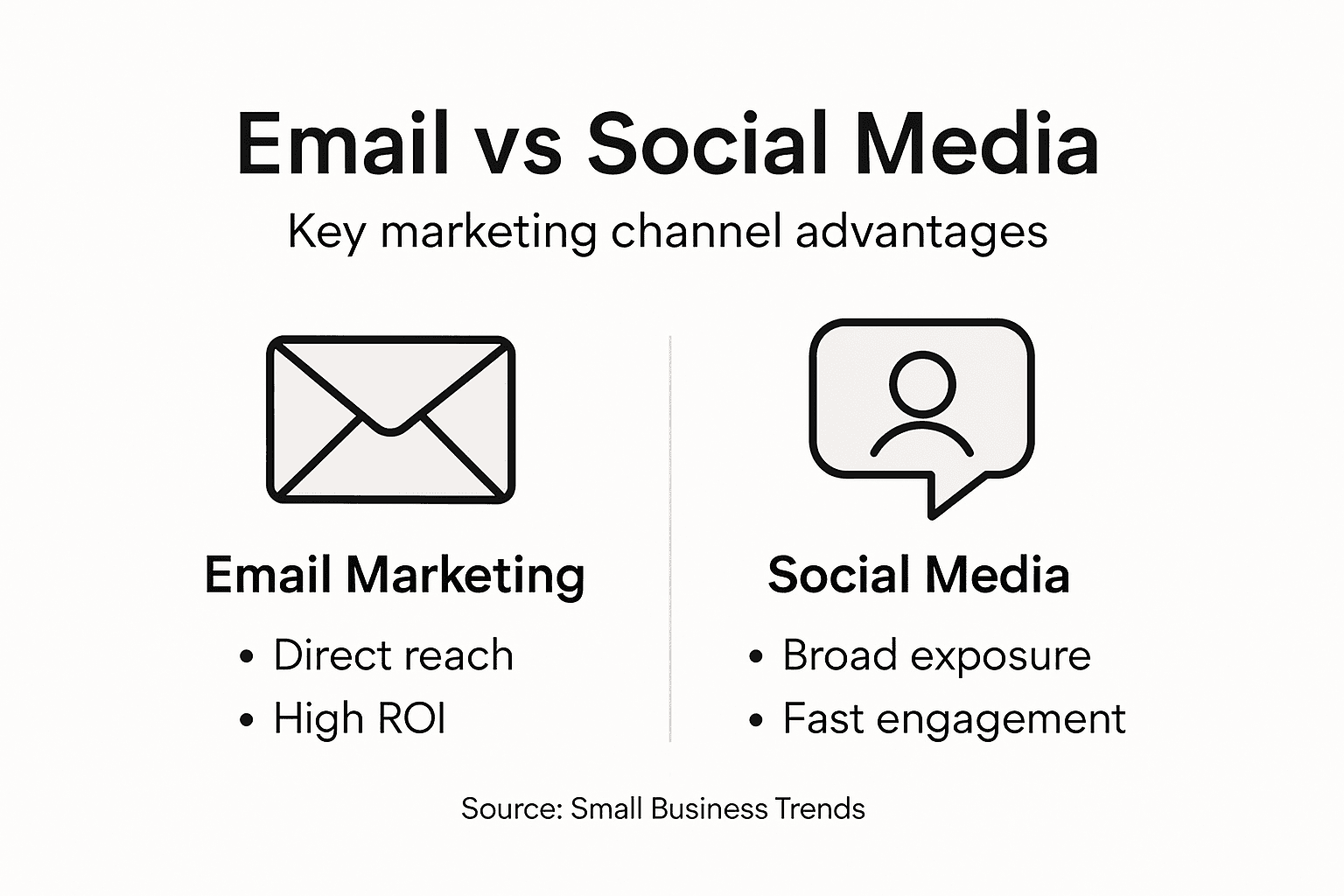
Email marketing provides substantial economic benefits that social media cannot replicate. The return on investment for email campaigns consistently outperforms social media marketing, with lower costs and higher conversion rates. Small businesses can track precise metrics like open rates, click-through rates, and direct sales conversions, giving them clear insights into their marketing performance. Social media interactions remain more nebulous, with engagement often translating poorly into actual business revenue. By investing in email marketing, companies create an owned communication asset that grows more valuable over time, unlike rented social media audience spaces.
Here’s a comparison of email marketing and social media for small businesses:
| Aspect | Email Marketing | Social Media |
|---|---|---|
| Audience Ownership | Full control of contact list | Platform-dependent and limited |
| Message Delivery | Direct to inbox, high visibility | Algorithm-driven, unpredictable |
| Personalization | Highly targeted, segmented | Broad, less personalized |
| ROI Tracking | Detailed metrics, conversion focused | Harder to link to direct sales |
Pro tip: Create a lead magnet that incentivizes email sign-ups, transforming casual social media interactions into valuable, owned customer relationships.
Common Email Marketing Challenges and Solutions
Email marketing performance demands strategic navigation through complex technical and regulatory landscapes. Small businesses encounter numerous obstacles that can compromise campaign effectiveness, including deliverability issues, engagement dropoff, and stringent privacy requirements. Understanding these challenges becomes crucial for developing resilient marketing strategies that consistently reach and resonate with target audiences.
The most significant challenges emerge from list management, content relevance, and technical constraints. Poor list hygiene can devastate sender reputation, causing emails to be flagged as spam or blocked entirely. Small businesses must implement rigorous list cleaning processes, regularly removing inactive subscribers and ensuring accurate contact information. Mobile responsiveness represents another critical challenge, with over 60% of emails now opened on mobile devices. Designing emails that render perfectly across different screen sizes and email clients requires careful development and consistent testing.
Compliance and data protection pose additional complexity for email marketers. Privacy regulations like CAN-SPAM and GDPR mandate strict protocols for data collection, consent, and user communication. Businesses must implement transparent opt-in processes, provide clear unsubscribe mechanisms, and maintain meticulous records of subscriber consent. Tracking meaningful engagement metrics becomes essential, moving beyond simple open rates to analyze click-through rates, conversion performance, and long-term subscriber value. By adopting a proactive, data-driven approach, small businesses can transform these challenges into opportunities for more sophisticated, targeted communication.
Pro tip: Conduct a quarterly email list audit to remove inactive subscribers, verify contact information, and maintain high deliverability rates.
Unlock the Power of Email Marketing for Your Small Business
Many small businesses struggle with creating consistent, personalized communication that drives sales and builds lasting customer relationships. The challenges of managing email lists, crafting relevant content, and automating campaigns to save time can feel overwhelming. If you want to overcome these pain points and harness the true benefits of email marketing as described in the article, you need a trusted guide and platform to help you build your silent sales machine.
emailedgar.com specializes in transforming your email list into a powerful revenue engine through automated, effective campaigns tailored to your unique business goals. Imagine having a system that works 24/7 to nurture leads, increase engagement, and convert subscribers into loyal customers without constant manual effort. Start with expert coaching, actionable strategies, and tools designed specifically for small business owners who want to master email marketing with ease.
Unlock the full potential of your email marketing approach today with emailedgar.com.
Are you ready to take control of your customer communication and see measurable growth?
Visit emailedgar.com to learn more about building your list fast, automating your sales emails, and accessing free resources that empower your marketing success now.
Frequently Asked Questions
What are the main benefits of email marketing for small businesses?
Email marketing allows small businesses to create personalized, scalable connections with customers, leading to increased engagement and conversion rates. It is also cost-effective, providing an average return of $36 for every $1 invested.
How can small businesses effectively segment their email lists?
Small businesses can segment their email lists based on factors like purchase history, engagement levels, and demographics. This allows for tailored messaging that resonates with specific customer groups, enhancing the relevance and impact of each email.
What types of email campaigns should small businesses consider?
Small businesses should consider various email campaign types such as welcome emails to onboard subscribers, promotional emails for driving sales, newsletters for maintaining relationships, and transactional emails for confirming actions like purchases and shipping updates.
How does email automation improve marketing efforts for small businesses?
Email automation enables businesses to send targeted messages based on customer behaviors without constant manual intervention. This streamlines marketing workflows, enhances customer engagement, and allows for timely, relevant communication at scale.