

Over 4.3 billion people worldwide use email daily, making it a reliable channel for reaching customers in nearly every market. For American and international e-commerce entrepreneurs, finding affordable ways to automate sales and build better relationships is a top priority. Email marketing stands out as a practical, scalable approach, offering clear insights into its basic concepts, campaign types, automation methods, and vital legal rules for long-term success.
Table of Contents
- Defining Email Marketing And Core Concepts
- Popular Email Marketing Types And Campaigns
- How Email Marketing Automation Works
- Key Benefits And Common Misconceptions
- Legal Compliance And Risks To Avoid
Key Takeaways
| Point | Details |
|---|---|
| Effective Email Marketing Requires Personalization | Understanding customer preferences is essential for creating relevant, engaging content. Use segmentation to tailor messages to specific audiences. |
| Automation Enhances Campaign Efficiency | Implementing automation workflows allows for timely, targeted messaging, improving engagement and conversion rates. |
| Legal Compliance is Crucial | Adhering to regulations like the CAN-SPAM Act and GDPR is necessary to avoid fines and protect brand reputation. |
| Focus on Value, Not Just Sales | Provide content that addresses customer needs, fostering trust and loyalty rather than just pushing products. |
Defining Email Marketing and Core Concepts
Email marketing represents a strategic digital communication approach where businesses send targeted messages directly to customers through electronic mail. At its core, this powerful marketing technique allows companies to build relationships, promote products, and drive conversions by delivering personalized content straight to an individual’s inbox. Email marketing strategies have become increasingly sophisticated as technology enables more precise targeting and automation.
The fundamental components of email marketing include audience segmentation, content creation, campaign design, and performance tracking. Successful email marketing goes beyond simple mass messaging – it requires understanding customer preferences, crafting compelling subject lines, and delivering value through relevant, timely information. Small business owners can leverage email marketing to nurture leads, announce promotions, share updates, and maintain consistent communication with their customer base without significant advertising expenses.
Modern email marketing integrates advanced technologies like artificial intelligence and data analytics to enhance personalization and engagement. Businesses can now use tools that analyze customer behavior, predict optimal sending times, and automatically adjust content based on individual user interactions. This level of precision transforms email from a basic communication channel into a sophisticated marketing instrument that can dramatically improve customer retention and sales conversion rates.
Pro tip: Start by building a quality email list with subscribers who genuinely want your content, focusing on organic growth through valuable offerings rather than purchasing contact databases.
Popular Email Marketing Types and Campaigns
Email marketing encompasses several strategic campaign types designed to achieve specific business objectives. Businesses leverage different email formats to engage customers throughout their journey, each serving a unique purpose in the marketing communication ecosystem. The most prominent email marketing types include promotional campaigns, transactional messages, newsletters, welcome series, lead nurturing sequences, and re-engagement initiatives.
Promotional emails represent the most direct marketing approach, focusing on driving immediate sales through special offers, discounts, and product announcements. Transactional emails, such as order confirmations and shipping notifications, provide critical information while simultaneously offering opportunities for additional engagement. Newsletters serve a different function, delivering valuable content that keeps subscribers informed and connected to the brand without direct selling pressure. Welcome emails play a crucial role in setting initial expectations and building early relationship foundations with new subscribers.
Automated email campaigns have revolutionized marketing effectiveness by enabling precise targeting and personalization. Advanced segmentation techniques allow businesses to create highly tailored messaging that responds to specific customer behaviors, preferences, and interaction histories. These sophisticated campaigns can automatically trigger based on user actions, such as abandoned cart notifications, birthday greetings, or personalized product recommendations, ensuring timely and relevant communication that feels individualized rather than generic.
Pro tip: Design your email campaigns with a clear understanding of your audience’s preferences, using segmentation to deliver more personalized and engaging content that resonates with specific customer groups.
Here’s how popular email marketing types differ in purpose and impact:
| Campaign Type | Primary Purpose | Typical Content | Business Impact |
|---|---|---|---|
| Promotional | Drive immediate sales | Offers, discounts, new products | Boosts short-term revenue |
| Transactional | Confirm or update transactions | Order info, shipping updates | Enhances trust, reduces confusion |
| Newsletter | Build ongoing relationship | News, tips, brand stories | Increases loyalty, brand awareness |
| Welcome Series | Introduce and onboard | Expectations, brand values | Improves engagement, educates |
| Re-engagement | Revive inactive subscribers | Reminders, special incentives | Recovers lost leads, prevents churn |
How Email Marketing Automation Works
Email marketing automation transforms traditional marketing by enabling businesses to create intelligent, responsive communication systems that operate with minimal manual intervention. Modern automation workflows leverage sophisticated triggers and predefined rules to deliver personalized messages precisely when customers are most likely to engage. These automated systems can track user behaviors, segment audiences, and generate contextually relevant communications without constant human management.

The core mechanics of email marketing automation involve setting up specific triggers and actions that respond to customer interactions. For instance, when a potential customer abandons a shopping cart, an automated sequence might send a reminder email after a set time period, potentially including a discount code to encourage completion of the purchase. Other common automation scenarios include welcome email series for new subscribers, birthday greetings, post-purchase follow-ups, and re-engagement campaigns targeting inactive customers. These automated workflows ensure consistent, timely communication that feels personalized and relevant to each individual recipient.
Advanced email marketing automation platforms now integrate artificial intelligence and machine learning capabilities to enhance targeting and predictive messaging. These technologies analyze vast amounts of customer data to optimize send times, predict likely engagement, and dynamically adjust content based on individual user preferences and historical interaction patterns. Small businesses can now access powerful automation tools that previously were available only to large enterprises, enabling more sophisticated marketing strategies without requiring extensive technical expertise or substantial additional resources.
Pro tip: Start by mapping out your customer journey and identifying key interaction points where automated emails can provide the most value, focusing on creating sequences that genuinely serve your audience’s needs.
Key Benefits and Common Misconceptions
Email marketing offers numerous strategic advantages for businesses across various industries, with research highlighting its exceptional cost-effectiveness and measurable return on investment. The primary benefits include direct audience communication, precise targeting, real-time performance tracking, and the ability to create personalized experiences at scale. Unlike traditional marketing channels, email allows businesses to segment audiences, customize messaging, and track engagement metrics with unprecedented granularity.
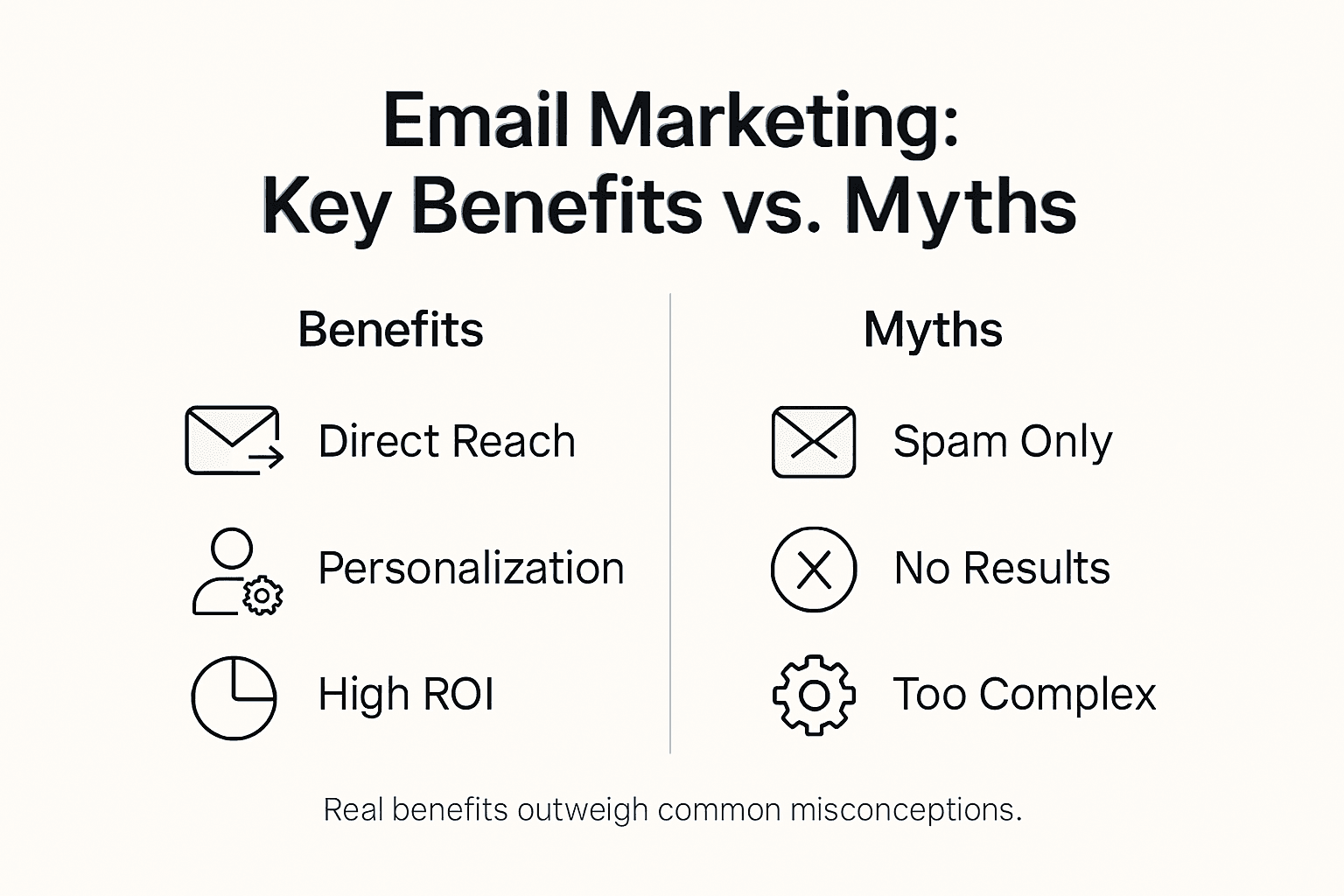
Despite its powerful capabilities, email marketing is often misunderstood. One common misconception is that email campaigns are inherently spammy or intrusive. In reality, when executed thoughtfully, email marketing provides genuine value to subscribers by delivering relevant, timely, and personalized content. Another prevalent myth suggests that email marketing is obsolete in the age of social media. However, email remains one of the most direct and effective communication channels, with significantly higher conversion rates compared to social media platforms.
The true power of email marketing lies in its ability to build and nurture customer relationships through consistent, meaningful interactions. Successful campaigns focus on providing value rather than purely promoting products. This approach involves understanding audience preferences, segmenting lists strategically, and creating content that addresses specific customer needs and pain points. Advanced marketers utilize sophisticated techniques like behavioral triggers, dynamic content, and predictive analytics to enhance engagement and drive meaningful business outcomes.
Pro tip: Invest time in understanding your audience’s preferences and create email content that solves their problems or fulfills their needs, rather than simply pushing sales messages.
Legal Compliance and Risks to Avoid
Global email marketing regulations present complex challenges for businesses operating across different jurisdictions, requiring a nuanced understanding of legal requirements. Different countries enforce distinct rules regarding consent, data protection, and communication practices. In the United States, the CAN-SPAM Act establishes clear guidelines, while the European Union’s General Data Protection Regulation (GDPR) imposes stringent requirements on data collection, storage, and individual privacy rights. These regulations mandate explicit consent, clear opt-out mechanisms, and transparent data handling practices.
The primary legal risks in email marketing revolve around unauthorized communication, improper data management, and failure to obtain proper consent. Businesses must implement robust processes to ensure subscribers actively choose to receive communications, maintain detailed records of consent, and provide easy unsubscribe options in every email. Violations can result in substantial financial penalties, ranging from hundreds to thousands of dollars per non-compliant email, potentially devastating smaller businesses. Additionally, repeated violations can damage brand reputation and lead to permanent restrictions on email marketing activities.
Effective legal compliance requires a comprehensive approach that goes beyond simple checkbox requirements. This involves developing clear consent protocols, maintaining detailed subscriber records, implementing secure data storage systems, and regularly auditing email marketing practices. Small businesses should pay particular attention to verifying subscriber origins, keeping consent documentation, segmenting lists appropriately, and ensuring that every communication provides genuine value to recipients. Regular training for marketing teams about evolving legal requirements and potential risks is crucial for maintaining ongoing compliance.
Pro tip: Consult with a legal professional specializing in digital marketing regulations to develop a comprehensive compliance strategy tailored to your specific business needs and target markets.
Below is a concise overview of major global email compliance standards and what they require:
| Regulation | Region | Consent Requirement | Key Risk for Non-Compliance |
|---|---|---|---|
| CAN-SPAM Act | United States | Unsubscribe option, clear source | Fines up to $43,280 per violation |
| GDPR | European Union | Explicit opt-in, data privacy | Heavy penalties, brand damage |
| CASL | Canada | Express consent, proof required | Financial penalties, restriction |
Take Control of Your Email Marketing Success Today
Struggling to turn your email list into a reliable sales engine is a common challenge highlighted in the article What Is Email Marketing and Why It Matters. You want to overcome obstacles like building a quality subscriber base, automating campaigns, and delivering personalized content that truly resonates. These goals are key to creating that silent sales machine that works 24 7 without burning you out or relying on sales staff.
At emailedgar.com we specialize in helping business owners master these exact challenges through proven strategies and automation tools. When you visit our site you gain access to expert coaching, free resources, and actionable insights on how to implement effective email marketing and nurture your leads with consistent engagement. Whether you are just starting or want to enhance your automated email sequences our platform guides you through step by step.
Discover how you can increase conversions by sending the right message at the right time without guesswork. Start turning casual subscribers into loyal buyers by exploring our email marketing solutions now. Don’t wait to build a powerful email list that keeps your brand top of mind. Visit emailedgar.com and take your first step toward email marketing success today.
Frequently Asked Questions
What is email marketing?
Email marketing is a strategic digital communication method that allows businesses to send targeted messages directly to customers via email. It is used to build relationships, promote products, and drive conversions through personalized content.
Why is email marketing important for businesses?
Email marketing is important because it offers direct communication with audiences, enables precise targeting, and allows for real-time performance tracking. It can drive significant engagement and sales, providing a measurable return on investment.
What are the main components of an effective email marketing campaign?
The main components of an effective email marketing campaign include audience segmentation, content creation, campaign design, and performance tracking. Successful campaigns focus on understanding customer preferences and delivering relevant information.
How does email marketing automation improve campaign effectiveness?
Email marketing automation enhances campaign effectiveness by allowing businesses to set triggers for sending personalized messages based on customer interactions, reducing the need for manual intervention. This leads to timely, relevant communication that can boost engagement and conversion rates.