

Over 80 percent of american businesses struggle to keep their email lists clean and effective. Managing your subscribers goes far beyond simple organization when every message impacts engagement and sales. With email automation rapidly changing how global brands connect, this guide reveals the secrets small businesses and digital marketers need to transform their outreach without letting list management become a stumbling block.
Table of Contents
- Email List Management Defined And Debunked
- Common Types And Key List Segmentation Strategies
- How Automation Optimizes Engagement And Results
- Legal Compliance And Subscriber Consent Best Practices
- Pitfalls, List Fatigue, And How To Avoid Them
Key Takeaways
| Point | Details |
|---|---|
| Email List Management is Essential | Successfully managing an email list involves strategic segmentation, active maintenance, and continuous optimization for effective subscriber communication. |
| Utilize Advanced Segmentation Techniques | Employ demographic, behavioral, geographic, and transactional segmentation to personalize campaigns and drive engagement. |
| Implement Automation for Efficiency | Use marketing automation platforms to create intelligent workflows that respond to user actions and enhance personalized communication. |
| Ensure Legal Compliance | Always obtain explicit consent from subscribers and maintain transparent communication to avoid compliance issues and build trust. |
Email List Management Defined and Debunked
Email list management is the systematic process of organizing, maintaining, and optimizing a collection of email addresses for targeted communication and marketing purposes. At its core, it involves strategically handling email databases to ensure effective outreach and engagement with subscribers.
The fundamental goal of email list management goes beyond simply collecting email addresses. It requires strategic segmentation, active maintenance, and continuous optimization of your subscriber database. This means regularly cleaning invalid email addresses, tracking subscriber interactions, understanding engagement metrics, and creating personalized communication pathways that resonate with different audience segments.
Effective email list management involves several critical components: subscriber acquisition, permission-based marketing, data hygiene, segmentation, and consistent communication. Businesses must implement robust systems that automate mailing list processes while maintaining high-quality, relevant interactions. This approach transforms a static email list into a dynamic marketing asset that drives customer relationships and generates sustainable revenue.
Pro Tip: Implement a quarterly email list audit to remove inactive subscribers and maintain a high-quality, engaged audience database.
Common Types and Key List Segmentation Strategies
Email marketing relies on sophisticated audience segmentation techniques to deliver targeted and personalized communication. By categorizing subscribers into specific groups, businesses can create more meaningful and engaging email campaigns that resonate with different audience segments.
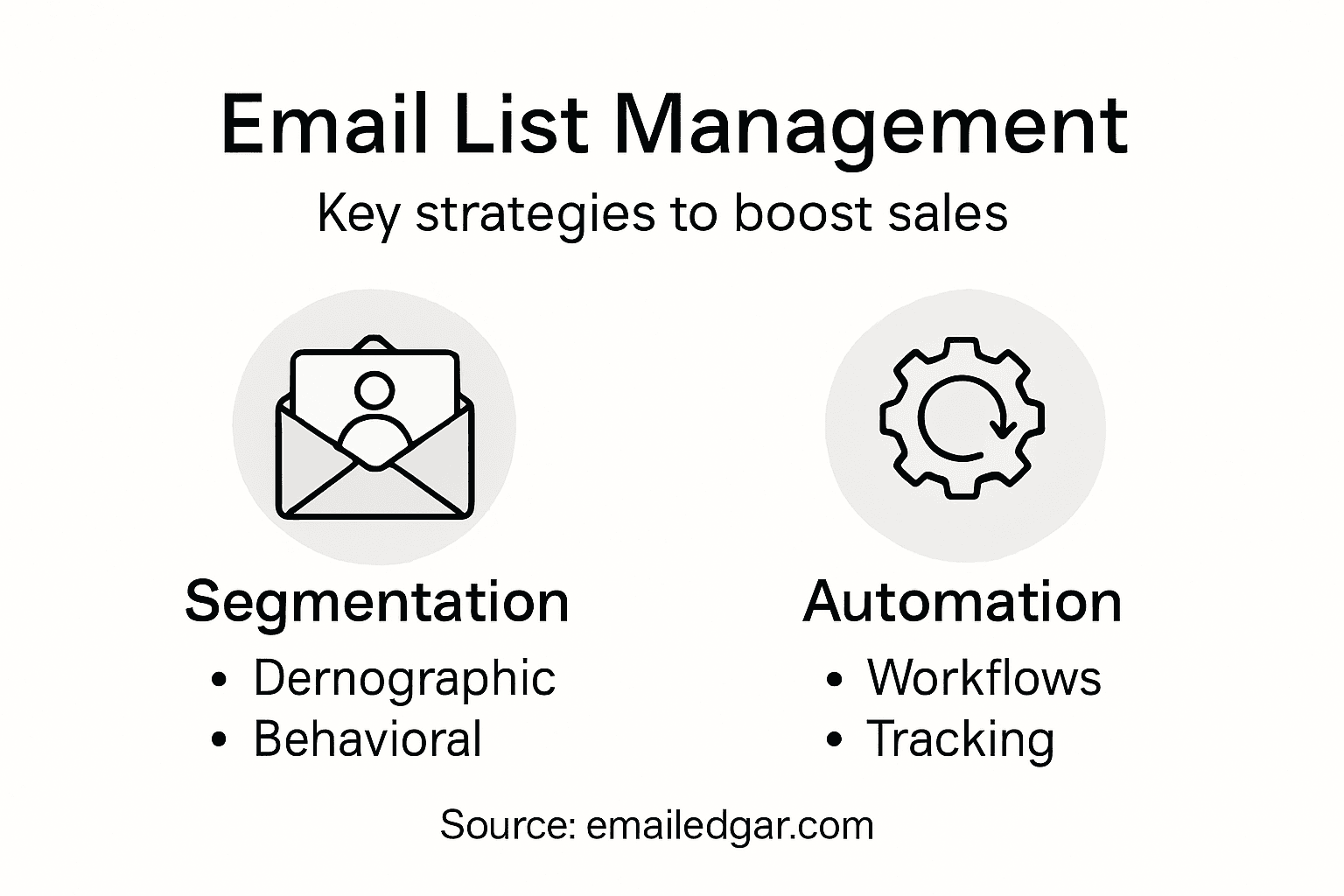
The primary types of email list segmentation include demographic, behavioral, geographic, and transactional categories. Demographic segmentation breaks down subscribers by age, gender, income level, and professional background. Behavioral segmentation tracks subscriber interactions, including purchase history, email engagement rates, website activity, and specific content preferences. Geographic segmentation allows businesses to customize messaging based on location, time zones, and regional characteristics, while transactional segmentation focuses on subscribers’ purchasing patterns and previous interactions with the brand.

Here’s a concise overview of key email list segmentation types and their marketing benefits:
| Segmentation Type | Description | Marketing Benefit |
|---|---|---|
| Demographic | Targets age, gender, income | Personalizes offers and messaging |
| Behavioral | Tracks user actions and habits | Increases engagement and relevance |
| Geographic | Focuses on location-based traits | Enables regional promotions |
| Transactional | Uses purchase history | Drives repeat sales and loyalty |
Email marketing strategies typically involve creating multiple segmented lists that enable precise targeting. This might include separating new subscribers from long-term customers, identifying high-value clients, or creating specialized groups based on specific interests or engagement levels. By developing nuanced segmentation approaches, businesses can dramatically improve email campaign performance, increase open rates, and generate more meaningful customer connections.
Pro Tip: Develop a dynamic segmentation strategy that automatically updates subscriber categories based on real-time behavioral data and interaction patterns.
How Automation Optimizes Engagement and Results
Email automation transforms traditional marketing approaches by enabling businesses to create intelligent, responsive communication systems. Marketing automation platforms integrate sophisticated technologies that track subscriber behaviors, trigger personalized messages, and optimize engagement across multiple communication channels.
The core mechanics of email automation involve creating intelligent workflows that respond dynamically to specific user actions. These systems can automatically segment subscribers, track interaction metrics, and deliver precisely timed messages based on individual user behaviors. For instance, a new subscriber might receive a welcome sequence, while a customer who abandoned a shopping cart could trigger a targeted recovery email. By implementing automated email systems businesses can dramatically reduce manual intervention while maintaining a high level of personalized communication.
Successful email automation strategies typically incorporate several key elements: behavioral tracking, lead scoring, triggered messaging, and comprehensive analytics. These components work together to create a seamless system that nurtures potential customers through their entire journey, from initial contact to conversion. By leveraging sophisticated automation tools, businesses can transform email from a static communication channel into a dynamic, responsive marketing engine that adapts in real-time to customer interactions.
Consider these aspects when choosing email automation tools for your business:
| Feature | Why It’s Important | Typical Business Impact |
|---|---|---|
| Behavioral Tracking | Monitors subscriber activity | Improves targeting and timing |
| Triggered Messaging | Sends emails based on actions | Boosts conversions and engagement |
| Lead Scoring | Ranks prospects by interest | Prioritizes valuable leads |
| Analytics Reporting | Measures campaign results | Refines future marketing |
Pro Tip: Implement a multi-step automation workflow that gradually increases message complexity based on subscriber engagement levels and demonstrated interests.
Legal Compliance and Subscriber Consent Best Practices
Email marketing requires strict adherence to legal standards that protect subscriber rights and maintain ethical communication practices. Comprehensive email regulations mandate specific requirements for commercial email communications, establishing clear guidelines for businesses to follow when engaging with their audience.
Key legal compliance elements include obtaining explicit consent, providing transparent opt-out mechanisms, and maintaining accurate sender information. Subscriber consent must be freely given, specific, and informed, which means businesses need to design clear consent processes that explicitly explain how subscriber data will be used. Consent notice design plays a critical role in ensuring subscribers understand and willingly agree to receive marketing communications, with regulations like GDPR requiring businesses to implement robust consent mechanisms.
Businesses must implement comprehensive strategies to maintain legal compliance, including maintaining detailed records of subscriber consent, creating easy unsubscribe processes, and regularly updating consent documentation. This involves developing clear communication protocols that respect subscriber preferences, provide transparent information about data usage, and consistently honor opt-out requests. Failure to comply with these regulations can result in significant financial penalties and damage to brand reputation.
Pro Tip: Develop a standardized consent collection process that includes clear language, explicit permissions, and documented timestamp of subscriber agreement.
Pitfalls, List Fatigue, and How to Avoid Them
Email list management requires strategic approaches to prevent subscriber disengagement and maintain high-quality communication channels. Effective email management involves understanding the subtle dynamics that lead to list fatigue and implementing proactive strategies to keep subscribers engaged and interested.
The primary pitfalls in email marketing include sending excessive emails, failing to segment audiences appropriately, and neglecting subscriber preferences. List fatigue emerges when subscribers feel overwhelmed by irrelevant or repetitive content, leading to decreased open rates, reduced engagement, and higher unsubscribe rates. Email list optimization strategies recommend implementing the 80/20 rule, where 80% of communications provide genuine value and only 20% focus on direct promotions.
To combat list fatigue, businesses must develop sophisticated engagement strategies that prioritize subscriber experience. This involves creating dynamic content that adapts to individual subscriber behaviors, implementing intelligent segmentation techniques, and establishing clear communication frequency guidelines. Regular list maintenance, including removing inactive subscribers and allowing easy preference management, helps maintain a healthy and responsive email list that delivers meaningful interactions.
Pro Tip: Conduct quarterly subscriber preference surveys to understand evolving audience interests and adjust your email communication strategy accordingly.
Unlock the Power of Smart Email List Management Today
Struggling with managing your email list to boost sales and keep your audience engaged? The article highlights common challenges like list fatigue, segmentation complexity, and the need for automation to maintain consistent, personalized communication. If you want to transform your email list into a dynamic sales engine that works around the clock without overwhelming your subscribers, this is your perfect solution.
At emailedgar.com, we specialize in helping businesses implement proven email marketing strategies that automate segmentation, boost engagement, and nurture your leads effortlessly. Our platform guides you through building a highly targeted and consent-compliant email list, preventing subscriber fatigue while maximizing sales opportunities.
Take control of your email marketing success now by visiting emailedgar.com. Learn how to build your own silent sales machine with expert coaching and free resources designed to help you automate your email campaigns, increase conversions, and grow your business without added stress.
Frequently Asked Questions
What is email list management?
Email list management is the systematic process of organizing, maintaining, and optimizing a collection of email addresses for targeted communication and marketing purposes. It goes beyond just collecting email addresses to include segmentation, active maintenance, and continuous optimization of the subscriber database.
How can segmentation improve email marketing campaigns?
Segmentation allows businesses to categorize subscribers into specific groups based on demographics, behaviors, geography, and transaction history. This targeted approach leads to more relevant and personalized communications, increasing engagement and improving overall campaign performance.
What role does automation play in email list management?
Email automation enables businesses to create responsive communication systems by automatically sending personalized messages based on user behaviors. This reduces manual work and enhances engagement through timely, relevant content tailored to subscribers’ interactions with the brand.
What are the legal requirements for obtaining subscriber consent in email marketing?
Legal requirements for subscriber consent include obtaining explicit permission to communicate, providing a transparent opt-out mechanism, and maintaining accurate sender information. Businesses must ensure that consent processes clearly explain how subscriber data will be used and keep detailed records of this consent.