

Sorting through a crowded inbox, every digital marketer wonders why some campaigns spark action while others fall flat. For small e-commerce businesses, understanding subscriber differences is the foundation for real results. Focusing on actionable, measurable, and substantial market segments helps businesses tailor messages that drive engagement and sales. Learn how clear goals, organized data, and strategic automation can reshape your approach and bring true value to every email you send.
Table of Contents
- Step 1: Define Segmentation Goals And Criteria
- Step 2: Collect And Organize Subscriber Data
- Step 3: Create Targeted Email Segments
- Step 4: Personalize And Automate Campaigns
- Step 5: Test Segments For Engagement
Quick Summary
| Key Insight | Explanation |
|---|---|
| 1. Define clear segmentation goals | Establish specific objectives such as increasing repeat purchases by a quantifiable percentage to guide your segmentation strategy. |
| 2. Gather and clean subscriber data | Audit existing data for demographics and behaviors, then eliminate duplicates and inconsistencies to ensure accurate segmentation. |
| 3. Create targeted email segments | Group subscribers based on relevant behaviors or demographics, ensuring each segment is large enough to warrant focused marketing. |
| 4. Personalize and automate emails | Use subscriber names and tailor messages based on purchase history to enhance engagement and drive revenue through automation. |
| 5. Test segments for engagement | Measure key metrics like open and click-through rates to evaluate segment performance, using A/B tests to refine your approach. |
Step 1: Define segmentation goals and criteria
Before you split your email list into segments, you need to know exactly what you’re trying to accomplish. Are you aiming to increase open rates for a specific product line? Do you want to reduce unsubscribes by sending relevant content? Maybe you’re focused on getting repeat customers to buy again within 30 days. Your goals shape everything that comes next, so spending time here saves you from building segments that don’t actually drive business results.
Start by identifying what success looks like for your business. Think about the metrics that matter most: revenue per segment, conversion rate improvements, or customer lifetime value. Then define the criteria you’ll use to separate your subscribers. Effective market segmentation requires segments that are accessible (you can actually reach them affordably), actionable (they respond to your marketing), measurable (you can track their size and value), and substantial (they’re large enough to be worth your effort). This means if you’re segmenting by past purchase behavior, make sure you have enough data to actually identify these groups and enough people in each segment to justify the work.
Get specific about what divides your audience. Maybe you segment by purchase history, so you have “first-time buyers” and “repeat customers.” Or maybe it’s based on engagement level, splitting “active openers” from “inactive subscribers.” Could be product interest, geographic location, or time since last purchase. The key is choosing criteria that directly connect to your goals. If your goal is to increase product sales for a specific category, segmenting by that product interest makes sense. If your goal is to win back inactive subscribers, segmenting by engagement level is the move.
Pro tip Write down 2-3 specific goals with actual numbers (not “increase sales” but “increase repeat purchase rate by 20% within 90 days”) and list the data you already have access to before you start building segments, so you don’t end up creating segments you can’t actually target.
Step 2: Collect and organize subscriber data
You can’t segment what you don’t understand. This step is about gathering the right information about your subscribers and organizing it in a way that actually works for your segmentation strategy. The data you collect now becomes the foundation for everything else, so getting this right matters more than you might think.
Start by auditing what data you already have access to. Most small e-commerce businesses have basic information like email addresses and purchase history sitting in their systems right now. Look for demographic details (location, age if available), purchase behaviors (what they bought, when, how much they spent), engagement metrics (email opens, click rates, time since last purchase), and preferences they’ve indicated. Customer segmentation relies on comprehensive data collection that includes behaviors, demographics, and preferences, so cast a wide net when thinking about what information matters. Then comes the unglamorous but critical part: cleaning your data. Remove duplicate email addresses, fix formatting inconsistencies, and identify missing values. If someone never specified their location, you’ll need to decide whether to exclude them from location-based segments or leave that field blank. A messy data foundation creates messy, unreliable segments that send the wrong message to the wrong people.
Organize your data into categories that connect back to your segmentation goals from Step 1. If your goal is to increase repeat purchases among past customers, organize your data by purchase frequency and date. If you want to reduce inactive subscriber churn, track engagement metrics like last email open date or last click date. Think about how you’ll actually use each piece of information when creating segments. You don’t need to collect everything possible, just what helps you target subscribers with relevant emails. Make sure you’re also staying compliant with privacy regulations in your region. Getting subscriber consent for data collection and understanding what information you’re legally allowed to store protects your business and builds trust with your audience.

Pro tip Export your subscriber data into a spreadsheet and manually check the first 50 rows for inconsistencies, duplicates, or missing information so you catch data quality issues before they affect your entire segmentation strategy.
Step 3: Create targeted email segments
Now that you have clean data and clear goals, it’s time to actually build your segments. This is where your strategy becomes real. You’ll take all that subscriber information and group people who behave similarly or share characteristics that matter for your business. The segments you create here determine whether your emails land with impact or end up ignored.
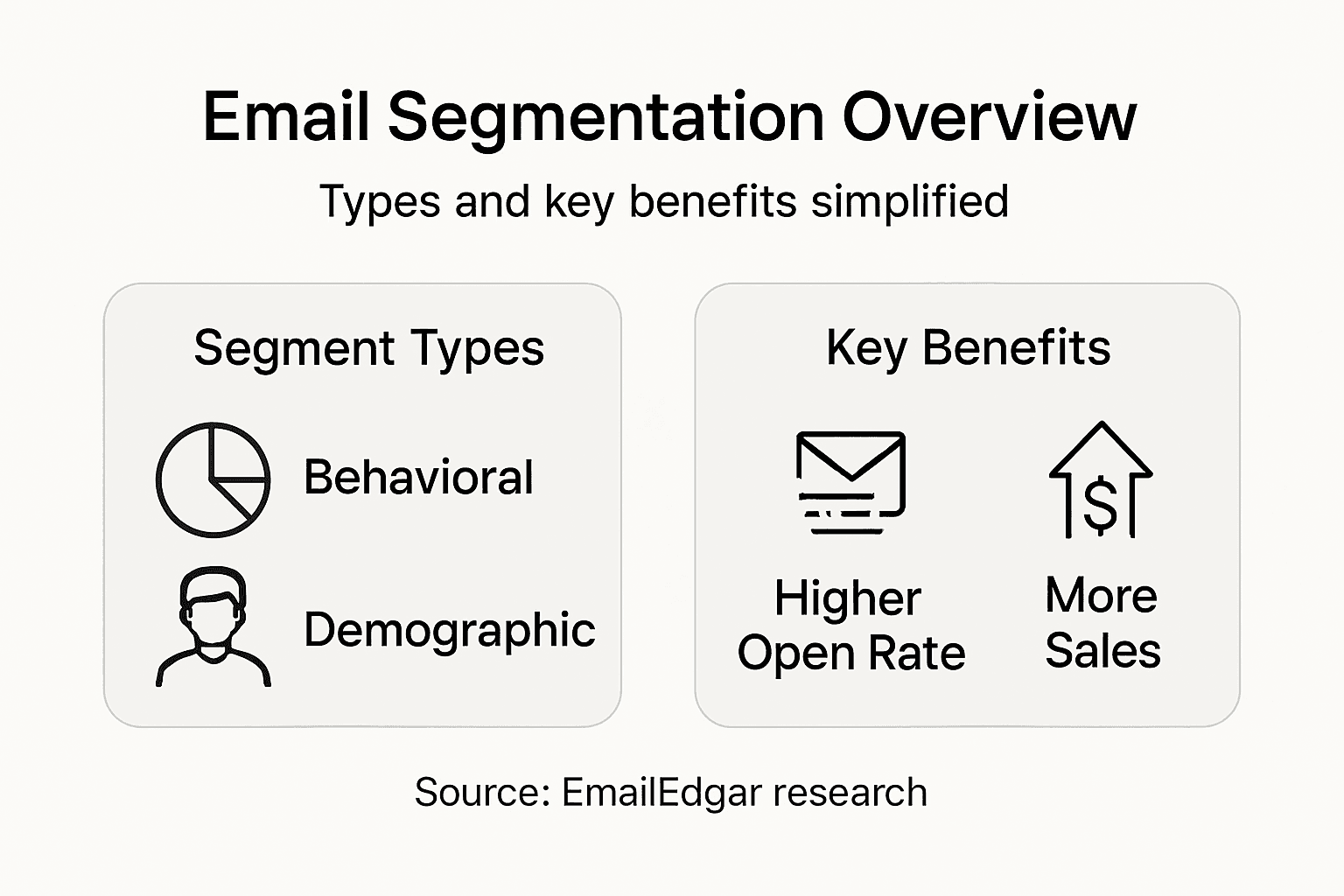
Start by choosing your segmentation approach based on what data you have and what your goals require. Behavioral segmentation methods analyze how customers act, what they purchase, and when they engage. Demographic segmentation groups people by age, location, or other personal attributes. Geographic segmentation targets specific regions where you operate or where your customers concentrate. Psychographic segmentation focuses on interests, values, and lifestyle patterns. Most small e-commerce businesses start with behavioral or demographic approaches because these are easiest to implement with existing data. For example, you might create segments like “purchased in the last 30 days,” “purchased 3 to 6 months ago,” and “never purchased.” Or you could segment by product category, location, or email engagement level. The key is making segments that actually respond differently to your messaging. A customer who bought winter boots last month needs different communication than someone who bought beach gear in August.
Build your segments one at a time, starting with the highest priority goal from Step 1. Use your cleaned data to identify the specific criteria that define each segment. If you’re segmenting by purchase recency, set exact date ranges. If you’re segmenting by product interest, specify which products or categories qualify. Make your segment rules clear and repeatable so that new subscribers automatically fall into the right groups as your list grows. Test your segment logic before launching any campaigns. Pull a sample of subscribers from each segment and manually verify they actually match your criteria. Nothing ruins engagement faster than sending “customers who abandoned carts” emails to people who never browsed anything. Once you confirm your segments are accurate, you’re ready to tailor your messaging to each group.
Here’s a comparison of common email segmentation approaches and their primary business benefits:
| Segmentation Type | Criteria Example | Main Benefit | Typical Use Case |
|---|---|---|---|
| Behavioral | Purchase recency | Drives timely, relevant offers | Promoting repeat purchases |
| Demographic | Age, gender, income | Improves audience targeting | Tailoring product promotions |
| Geographic | Location, region | Enables local event or store offers | Regional marketing campaigns |
| Psychographic | Interests, lifestyle | Connects with personal values | Launching new product lines |
Pro tip Start with no more than three to five core segments and make them large enough to matter, then add more refined segments later as you understand your audience better and collect more behavioral data over time.
Step 4: Personalize and automate campaigns
Segmented email lists only work if you actually send different messages to different groups. This step is where personalization and automation come together to create emails that feel like they were written just for each subscriber. When done right, automated personalized emails dramatically increase open rates, clicks, and sales without requiring you to manually write and send hundreds of emails.
Start with the simplest form of personalization: using subscriber names and other basic information in your emails. Including someone’s first name in the subject line or greeting increases their attention immediately. But real personalization goes much deeper. Email personalization that includes consumer-specific information like purchase history and interests significantly boosts open rates and sales. For your repeat customers segment, reference products they’ve bought before or recommend items similar to their past purchases. For first-time buyers, send them a welcome sequence that educates them about your brand and offers support. For inactive subscribers, send a “we miss you” campaign with a special offer to win them back. Each segment receives messaging tailored to their actual behavior and relationship with your business.
Now connect your personalization to automation. This is where the magic happens and your email list becomes a true sales machine. Set up automated workflows that trigger based on actions your subscribers take. When someone makes a purchase, trigger a thank you email followed by a product recommendation three days later. When someone abandons a cart, send a reminder after a few hours with a discount code. When someone hasn’t opened an email in 60 days, send them a re-engagement campaign. Campaign automation combined with personalization increases open rates and revenue by delivering meaningful content that matches each subscriber’s behavior. The key is mapping out the customer journey for each segment and building email sequences that guide them toward your business goal, whether that’s making a first purchase, buying again, or staying engaged with your brand.
Pro tip Map out three core automated sequences (welcome series for new subscribers, post-purchase follow-up, and reactivation campaign) before trying to build dozens of complex workflows, as these three sequences alone typically generate 30 to 40 percent of automated email revenue.
Step 5: Test segments for engagement
You’ve built your segments and created personalized campaigns. Now comes the part that separates guessing from knowing: testing how your segments actually respond to your emails. Testing reveals whether your segments are truly engaged or if your messaging is missing the mark. Without testing, you’re flying blind and leaving money on the table.
Below is a summary of key metrics used to evaluate engagement across segments:
| Metric | Indicates | Why It Matters |
|---|---|---|
| Open Rate | Subject line and sender effectiveness | Measures initial interest |
| Click-Through Rate | Content and call-to-action appeal | Tracks audience engagement |
| Conversion Rate | Ability to drive desired action | Reveals campaign success |
| Unsubscribe Rate | Frequency of irrelevant messaging | Flags audience dissatisfaction |
Start by identifying the metrics that matter most for each segment. Open rates tell you if your subject line and sender name resonate. Click-through rates show whether your content and call-to-action actually interest people. Conversion rates prove whether the email actually drives the business result you want. Unsubscribe rates reveal if you’re sending the wrong message to the wrong people. Testing engagement through different marketing strategies provides data on which segments respond best and guides optimization. For your repeat customer segment, track whether personalized product recommendations actually lead to purchases. For your inactive segment, measure whether a re-engagement offer brings people back. The key is tracking segment-specific results, not just overall campaign performance. Your welcome email might have a 45 percent open rate, but if only 10 percent of those openers click through, that’s a problem worth investigating.
Run A/B tests within each segment to optimize your messaging. Test different subject lines with one segment and measure which version gets more opens. Test different email copy or call-to-action buttons with another segment. Change one element at a time so you actually know what caused the difference. Analyzing how different audience segments respond to targeted messages helps you adjust strategies and avoid irrelevant messaging. After each test, document what you learned. Maybe your inactive segment responds better to urgency. Maybe your high-value customers prefer longer, educational emails. Use these insights to refine your segments further and improve your campaigns over time. This continuous testing cycle transforms email from a guessing game into a predictable revenue machine.
Pro tip Track at least five to seven campaigns per segment before drawing conclusions about performance, as single campaigns can have anomalies, but patterns emerge when you see consistent data across multiple sends.
Unlock the Power of Email Segmentation to Boost Your Business
Struggling to turn your email list into a reliable sales engine is a common challenge. This article highlights key pain points such as unclear segmentation goals, messy subscriber data, and the need for personalized automated campaigns. By focusing on effective behavioral and demographic segmentation, you lay the groundwork for targeted messages that increase engagement and conversions. Without the right tools, creating, testing, and automating these segments can feel overwhelming.
That is where emailedgar.com steps in. Our platform is built to help you organize your subscriber data cleanly, establish actionable segments based on proven criteria, and launch personalized, automated email sequences that work 24/7 to drive repeat purchases and customer loyalty. You will discover how to transform your email marketing from guesswork into a predictable revenue stream by leveraging strategies like welcome series, re-engagement campaigns, and product recommendations tailored to each segment.
Take control of your email marketing with real results from segmentation and automation today.
Boost your email effectiveness with expert insights and simple automation
Visit emailedgar.com to get started and learn how to craft segments that convert. Don’t wait to send the right message to the right subscriber at the right time. Your silent sales machine awaits.
Frequently Asked Questions
What are the steps for effective email segmentation?
To effectively segment your email list, start by defining your segmentation goals, collect and organize subscriber data, create targeted email segments, personalize and automate campaigns, and finally test segments for engagement. Outline specific goals like “increase repeat purchase rate by 20% within 90 days” and ensure you have clean data ready for segmenting.
How can I collect and organize subscriber data for segmentation?
Collect subscriber data by auditing existing information such as email addresses, purchase history, and engagement metrics. Organize this data into categories that align with your segmentation goals, ensuring it is clean and compliant with privacy regulations.
What criteria should I use to create email segments?
Choose criteria that directly connect to your business goals, such as purchase history, engagement levels, geographic location, or product interest. For example, segmenting by purchase recency could help you identify groups with different buying behaviors, allowing you to tailor your messaging effectively.
How can personalization improve my segmented email campaigns?
Personalization tailors your messaging to individual subscriber behaviors, significantly increasing open rates and click-through rates. Start by using the subscriber’s name and referencing their past purchases to create relevant content that resonates with each segment.
What metrics should I track to gauge segment engagement?
Key metrics to evaluate segment engagement include open rates, click-through rates, conversion rates, and unsubscribe rates. Track these metrics over multiple campaigns to identify patterns and make strategic adjustments to your messaging for better performance.
How do I test my email segments for effectiveness?
Test your segments by running A/B tests for different subject lines or content variations within each segment. Analyze the results to see which messages perform best, and document your findings to refine your approach going forward.