

Sending the same email to every customer often leaves your messages ignored or deleted. For small business owners across North America, this can mean missed sales and fading relationships. The truth is, targeted email segmentation creates measurable results by aligning content with each customer’s real needs, driving higher engagement and better returns. This article clears up common myths, explains practical segmentation methods, and shows how the right approach can transform your email marketing from a chore into a sales engine.
Table of Contents
- Defining Email Segmentation And Common Myths
- Methods For Segmenting Business Email Lists
- Top Email Segmentation Criteria For Small Businesses
- Impact Of Segmentation On Sales And Engagement
- Risks, Mistakes, And Compliance Considerations
Key Takeaways
| Point | Details |
|---|---|
| Email Segmentation Enhances Engagement | Targeted messages result in higher open and click-through rates, leading to increased sales. |
| Simplicity in Segmentation | Start with basic criteria like purchase behavior or engagement to improve effectiveness without complex tools. |
| Dynamic Segments Are Essential | Regularly update segments based on current subscriber behavior to maintain relevance and effectiveness. |
| Compliance is Crucial | Ensure explicit consent for data usage to avoid legal issues and protect subscriber privacy. |
Defining email segmentation and common myths
Email segmentation is the practice of dividing your subscriber list into smaller, more targeted groups based on specific criteria like purchase history, engagement level, location, or customer preferences. Instead of sending the same message to everyone on your list, you craft tailored messages for different groups. A customer who purchased gardening tools last month receives different offers than someone who visited your site but never bought anything. This targeted approach means higher open rates, better click-through rates, and ultimately more sales because each person receives content relevant to them.
The confusion around email segmentation often starts with outdated thinking. Many business owners assume they need sophisticated software or advanced technical skills to segment their lists. The reality is simpler. You can start segmenting with basic criteria like purchase history, email engagement, or signup source. When you understand what email list management actually involves, you realize that segmentation is a core component, not an optional add-on. Some business owners also believe segmentation requires massive lists to be worthwhile. This myth costs small businesses real revenue. Even with 500 subscribers, dividing them into two or three groups based on clear criteria produces measurable improvements in results. A restaurant owner might segment between “high-frequency diners” and “occasional visitors,” adjusting their promotions accordingly.
Another widespread misconception is that segmentation slows down your marketing efforts. The opposite is true. Yes, creating segments takes initial time. But once established, your sales process actually moves faster because you’re not wasting time on irrelevant pitches to people who cannot buy from you right now. A contractor targeting homeowners might segment by renovation budget or project timeline, ensuring their quotes reach the right people at the right time. This efficiency compounds over weeks and months as your sales cycles shorten and conversion rates climb.
Many small business owners also confuse segmentation with personalization, thinking they accomplish the same thing. Segmentation is the infrastructure that makes personalization possible. You segment first, then personalize within each segment. For example, you might segment by industry and then personalize within that industry segment by mentioning a specific pain point relevant to that business type. The segmentation creates the groups, and personalization adds the human touch that makes people actually open and read your emails.
Pro tip: Start with one simple segmentation based on your most obvious customer difference, like active buyers versus non-buyers or engaged subscribers versus inactive ones, then monitor your results for two weeks before adding complexity.
Methods for segmenting business email lists
Effective segmentation starts with knowing your data. Before you can divide subscribers into meaningful groups, you need to understand what information you’re actually tracking. Most business owners collect purchase history, signup source, engagement metrics, and basic demographics like location or industry. The key is reviewing this data intentionally and asking yourself which pieces actually matter for your business goals. A B2B software company might prioritize company size and industry, while an e-commerce store focuses on purchase frequency and average order value. You’ll never use every data point you collect, and that’s fine. The goal is identifying the criteria that directly influence buying behavior.
Once you know what data matters, organize it efficiently within your CRM or email platform. This is where many small business owners stumble because they think organization means perfection. You don’t need flawless data to start segmenting. You just need it organized well enough to take action. If 70 percent of your subscribers have accurate information in their purchase history field, you can segment based on that today without waiting for the remaining 30 percent to be perfect. Create clear naming conventions for your segments so you remember what criteria defines each group. A segment called “High Value” means nothing six months from now, but “Customers with 3+ purchases in past 12 months” tells you exactly who belongs there. When you understand the foundational role email lists play, you realize that segmentation quality directly impacts customer lifetime value.
The actual segmentation process involves selecting actionable criteria and testing effectiveness. Start with a simple segmentation based on one clear criterion, then measure results. Send one version of your email to segment A and a different version to segment B, tracking which performs better. This A/B testing reveals whether your segments actually respond differently or if you’re just creating extra work. After two to four weeks of tracking, you’ll know if the segmentation is worth maintaining. If both segments respond identically, merge them back together and try a different criterion. If one segment consistently outperforms the other, you’ve found something valuable.
Monitoring and adjusting segments continuously keeps them relevant as your business and customers evolve. A customer who purchased three times last year might have moved to a competitor this year. An engaged subscriber who opened every email six months ago could have abandoned you completely. Set a schedule to review segment performance monthly or quarterly depending on your email send frequency. Update subscriber data when they make new purchases, change their preferences, or show new engagement patterns. This ongoing maintenance prevents your segments from becoming stale and ineffective. Combine quantitative metrics like open rates and click-through rates with qualitative feedback from customer surveys or support conversations. Both data types reveal the complete picture of who your segments actually are and what they need from you.
Pro tip: Start with two segments based on purchase history (customers versus non-customers) and measure results after one month before creating additional segments, saving time while proving the method works.
Top email segmentation criteria for small businesses
Not all segmentation criteria are created equal for small business owners. You need to focus on what actually moves the needle for your specific customers and revenue goals. The most actionable segmentation criteria fall into four core categories: demographics, purchase behavior, engagement patterns, and customer preferences. Demographics like location, age, or industry help you understand who your customers are. Purchase behavior tells you what they actually do with your business. Engagement patterns reveal how interested they currently are in your messages. Preferences show what they want from you moving forward. A small manufacturing company might prioritize industry and company size, while a local service provider focuses heavily on location and past purchases. The key is choosing criteria that require minimal effort to track but deliver maximum impact on your revenue.
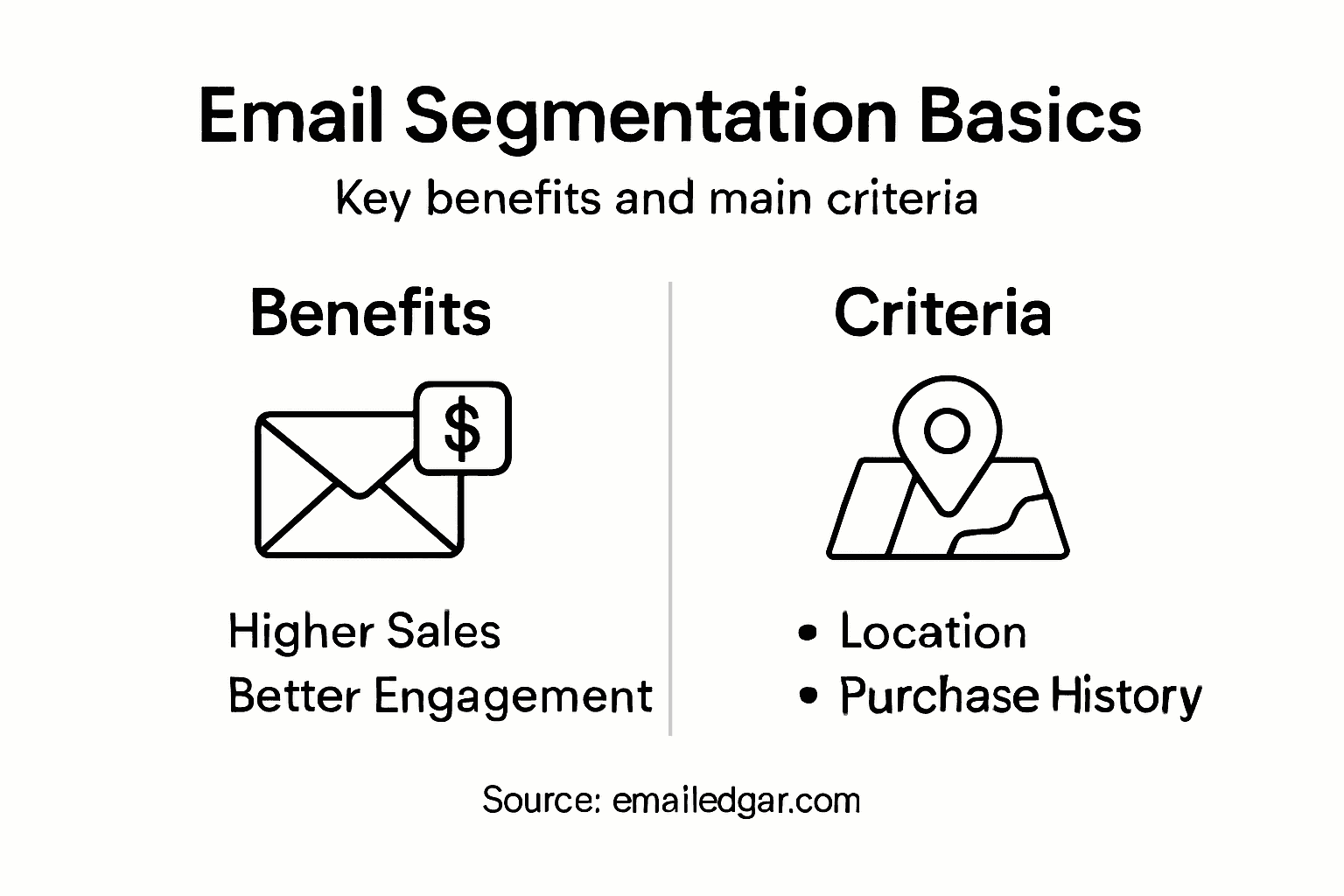
Location based segments deserve special attention for North American small businesses. If you serve customers in multiple cities, regions, or time zones, location segmentation is non negotiable. A landscaping company in Toronto operating across two provinces can send winter preparation tips to Northern customers while the Southern branch focuses on spring services. Location based segments facilitate timely promotions aligned with customer interests, meaning a retail store promotes its winter sale to customers in cold climates while advertising summer inventory to warmer regions. This relevance drives higher open rates and conversions because customers receive offers that match their actual climate and seasonal needs. Purchase behavior segmentation works alongside location. Track how often customers buy, when they last purchased, and how much they spend. A customer who spent $5,000 with you last month needs different communication than someone who made a single $50 purchase two years ago. High value repeat customers appreciate exclusive previews and loyalty rewards. Inactive customers need re-engagement campaigns with compelling reasons to return. New customers require onboarding sequences that build confidence in your product or service.
Email engagement metrics provide real time insight into subscriber interest. Track who opens your emails, clicks your links, and who ignores every message you send. Subscribers who open 80 percent of your emails clearly care about your content. Send them more detailed offers and insider information because they want it. Subscribers who haven’t opened anything in six months don’t need the same treatment. They need a different approach, like a simple “We miss you” campaign offering a discount to restart engagement or an easy unsubscribe option. Avoid wasting sends on completely uninterested subscribers. Their inactivity damages your sender reputation and wastes your time. Customer preferences round out your segmentation toolkit. During signup, ask what your subscribers care about most. Are they interested in product updates, special discounts, educational content, or industry news? If you run a B2B consulting firm, some subscribers want case studies while others want trend forecasts. Send each group what they actually requested. This respect for customer preferences builds trust and dramatically improves engagement. When you combine these segmentation approaches with campaign optimization practices, your entire email operation becomes more efficient and profitable.
Pro tip: Start with a single segment based on purchase frequency (active buyers in the past year versus inactive), then layer location second if you serve multiple geographic areas before adding demographic or preference based segments.
Here’s a comparison of common segmentation criteria and their business impacts:
| Segmentation Criterion | Typical Use Case | Business Impact |
|---|---|---|
| Location | Regional promotions | Higher local relevance, better ROI |
| Purchase Behavior | Loyalty and re-engagement campaigns | Increases repeat sales, retention |
| Email Engagement | Subscriber activity tracking | Improves deliverability, engagement |
| Customer Preferences | Content type selection | Builds trust, personalizes offers |
Impact of segmentation on sales and engagement
Segmented email campaigns deliver measurable results that directly impact your bottom line. When you stop sending generic messages to everyone and start targeting specific groups with relevant content, your open rates climb, your click-through rates improve, and most importantly, your sales increase. The numbers back this up consistently. Segmented campaigns typically achieve 14 to 100 percent higher open rates compared to non-segmented campaigns, depending on how precisely you’ve defined your segments and how relevant your content is. A plumbing contractor sending winter pipe protection tips only to customers in northern climates sees higher engagement than broadcasting the same message to subscribers in Florida. The relevance matters tremendously. When your message aligns with what each customer segment actually needs, they pay attention. Tailored messaging aligned with customer needs results in improved campaign response rates and higher sales volume, making segmentation a practical necessity rather than an optional tactic for any business serious about revenue growth.

Beyond open rates and clicks, segmentation transforms customer relationships and lifetime value. When subscribers consistently receive content they actually care about, they develop stronger loyalty to your brand. A customer who receives exclusive early access to new products because they’re in your high value segment feels appreciated and stays engaged longer. A price conscious customer appreciates targeted discount campaigns for budget conscious options. This targeted approach builds trust because customers recognize that you understand their specific situation and preferences. Research demonstrates that customer segmentation coupled with personalized marketing directly improves sales performance and customer retention, creating a compounding benefit over months and years. Retained customers purchase more frequently, refer others, and tolerate occasional mistakes better than customers who feel ignored or misaligned with your offers. Your customer lifetime value increases substantially when segmentation prevents the constant churn of disappointed subscribers who never felt like your marketing was meant for them.
Segmentation also dramatically improves your return on investment in email marketing by eliminating wasted effort. Every email you send costs something, even if it is just your time and your sender reputation. Sending irrelevant messages to uninterested subscribers wastes both. A contractor broadcasting expensive kitchen renovation offers to customers who only purchase maintenance services burns through email credits on people who will never convert. Segmentation redirects that effort toward subscribers who actually need what you’re offering. Your conversion rates rise because you’re reaching receptive audiences. Your cost per acquisition decreases because you’re not paying to reach everyone. Your sender reputation improves because you’re delivering relevant content that people want to receive, which means fewer complaints, unsubscribes, and spam reports. All of these benefits compound together into genuinely impressive business results. When marketers deliver relevant content that resonates with distinct audience segments, engagement metrics like open rates, click-through rates, and conversion rates increase measurably. The data-driven approach transforms email from an expensive broadcast tool into a precision sales instrument that works harder and smarter for you.
The real power of segmentation becomes apparent when you understand its role within your broader sales strategy. Segmented emails work better because they align with how modern sales processes actually drive automated revenue, moving customers through defined stages toward purchase decisions. A prospect in the awareness stage needs educational content about problems they might face and solutions available. That same prospect three months later, after multiple touches, needs specific pricing and comparison information. Segmenting by where customers sit in your sales journey ensures each person gets the right message at the right time. This coordination between segmentation and sales progression creates a silent sales machine that works 24/7 without requiring you to manually follow up with everyone. Your sales team wins because they receive better qualified leads. Your customers win because they get helpful information when they need it. Your business wins through increased revenue and reduced customer acquisition costs.
Pro tip: Track one metric closely for the first month after implementing segmentation: compare the conversion rate of your largest segment against your previous unsegmented campaign average to prove the method’s value before expanding to additional segments.
Risks, mistakes, and compliance considerations
Segmentation creates tremendous value, but careless implementation creates serious problems. The most common mistake is creating segments based on outdated or inaccurate criteria that no longer reflect your subscribers’ actual interests or behavior. You segment customers into “high value” based on purchases from two years ago, but they’ve been inactive for eighteen months. You maintain a segment for “interested in product launches” but never update it as your product line changes. Static segments become increasingly irrelevant over time, leading to lower engagement, more unsubscribes, and damage to your sender reputation. The solution is building dynamic segments that automatically update based on current behavior. A subscriber moves from “inactive” to “active” the moment they open an email or click a link. A customer graduates from “prospect” to “customer” immediately after their first purchase. Common mistakes in email segmentation include relying on static segments that do not update, sending irrelevant content due to poor criteria, and over-segmenting leading to unscalable groups. Each of these errors lowers engagement and increases unsubscribes, making your email list less valuable over time.
Over-segmentation presents a different but equally serious risk. You can slice your subscriber list so finely that individual segments become too small to manage effectively. Creating seventeen different segments for different purchase amounts sounds thorough, but it becomes unscalable quickly. You spend more time managing segments than actually sending emails. Each segment needs its own messaging, its own testing, its own monitoring. The math works against you. Start simple with two or three core segments and add complexity only when results prove it worthwhile. A startup with 2,000 subscribers cannot effectively maintain twelve different customer segments. Focus on the segments that represent meaningful revenue differences, not every possible customer variation. Another critical mistake is ignoring compliance requirements around data usage and consent. You cannot segment based on information you do not have explicit permission to use. Many North American businesses operate under strict regulations like Canada’s CASL, the United States CAN-SPAM Act, and if you have any Canadian or European customers, GDPR requirements apply regardless of where your business is located.
Compliance and legal considerations require serious attention. Email marketers must navigate compliance issues, particularly GDPR, emphasizing explicit consent before sending marketing emails, with risks of non-compliance including hefty fines and reputational damage. You cannot assume that having someone’s email address means you can segment them however you want. GDPR requires explicit consent for any data processing. CASL in Canada requires explicit opt-in before any marketing communication. CAN-SPAM in the United States requires honoring unsubscribe requests within ten business days and maintaining clean lists. When you segment, you are processing personal data based on customer information. That processing must be lawful and transparent. Best practices include obtaining clear, specific consent during signup about what you will do with subscriber data. Ask not just “can we email you?” but “what topics interest you?” so your consent also covers your segmentation strategy. Maintain detailed records of when and how you obtained consent from each subscriber. Honor opt-out and unsubscribe requests immediately, not at the end of your next campaign cycle. Never share segmentation data with third parties without explicit permission.
Data security and privacy protection matter enormously. Segmentation requires collecting and storing personal information about your subscribers. That data must be protected against unauthorized access. Use encrypted connections when transmitting subscriber data. Store it in secure systems with access controls. Delete data that you no longer need, following your data retention policies. Many small businesses keep detailed purchase history and engagement data indefinitely because it feels valuable. But old data can create liability without providing benefit. If a data breach occurs and criminals access five years of customer purchase history, your liability is greater than if you maintained only twelve months of current data. Be intentional about what you collect, how long you keep it, and who has access to it. Transparency builds trust. Tell your customers exactly how you use their data for segmentation. Explain that segmentation helps you send more relevant content. Show them how to update their preferences if their interests change. When customers understand that your segmentation exists to benefit them with better tailored communications, compliance becomes a shared commitment rather than a legal burden.
Pro tip: Before launching your segmentation strategy, document your compliance approach by writing down what data you collect, how you obtained consent, who has access to it, how long you keep it, and how you honor opt-out requests, then review this documentation quarterly as your business grows.
To help you avoid costly mistakes, here is a summary of common segmentation risks and their solutions:
| Risk | Description | Solution |
|---|---|---|
| Outdated Criteria | Segments don’t reflect current interests | Use dynamic, auto-updating groups |
| Over-Segmentation | Too many small, unmanageable segments | Start with a few, add slowly |
| Compliance Violations | Using data without proper consent | Obtain explicit, documented consent |
| Poor Data Security | Inadequate protection of subscriber data | Employ strong encryption, limit access |
Unlock the Full Power of Email Segmentation for Your Business
Many business owners struggle with outdated segmentation myths and complex data challenges that keep their email campaigns from reaching true potential. This article clearly points out how simple, targeted segmentation boosts engagement and sales by sending the right message to the right group. At emailedgar.com we understand these pain points and provide practical strategies to help you build dynamic segments that grow with your customers. We show you how to avoid over-segmentation and compliance mistakes so your email list stays healthy and profitable.
Imagine your email marketing becoming a silent sales machine working 24/7 to nurture leads and increase revenue. With guidance from our proven resources and coaching you will master segmentation concepts like purchase behavior and engagement patterns while integrating them seamlessly into your sales strategy. Stop wasting time and send irrelevant emails. Instead use your data wisely to create real results starting today.
Take action now and discover how to transform your email campaigns by visiting emailedgar.com. Learn more about effective email list management to get started on your segmentation journey. Explore the critical role of email lists in building lifelong customer relationships. Don’t miss the opportunity to automate your sales and boost conversions with expert advice available at your fingertips.
Frequently Asked Questions
What is email segmentation and why is it important?
Email segmentation is the process of dividing your subscriber list into smaller groups based on specific criteria, such as purchase behavior and engagement levels. It’s important because it allows you to send more relevant messages to each group, leading to increased open rates, click-through rates, and ultimately, higher sales.
How can small businesses implement email segmentation effectively?
Small businesses can implement email segmentation by starting with basic criteria, such as purchase history or engagement levels. Organizing subscriber data within your email platform is essential, as is regularly testing and measuring the effectiveness of different segments to refine your strategy continually.
What are some common criteria for segmenting email lists?
Common criteria for segmenting email lists include demographics (like age or location), purchase behavior (such as frequency or monetary value of purchases), engagement metrics (who opens or clicks emails), and customer preferences (what content they are interested in). Focus on criteria that align with your business goals for maximum impact.
How does email segmentation improve sales and engagement?
Email segmentation improves sales and engagement by ensuring recipients receive tailored messages that resonate with their interests and needs. This relevance boosts open and click-through rates, fosters customer loyalty, and increases the likelihood of conversions, ultimately enhancing overall sales performance.