

Sales growth and customer loyalty can feel unpredictable when every message blends into the background. For many American small business owners, capturing attention and building relationships is a daily challenge. Targeted email campaigns make it possible to connect with customers using personalized, well-timed messages rather than generic blasts. Discover how strategic automation, segmentation, and timing can turn casual subscribers into repeat buyers while saving valuable time and resources.
Table of Contents
- Email Campaigns Defined And Core Purpose
- Transactional Vs. Promotional Campaign Types
- Automated Drip And Nurture Campaigns Explained
- Segmentation, Personalization, And Timing Strategies
- Common Mistakes When Creating Email Campaigns
Key Takeaways
| Point | Details |
|---|---|
| Email Campaigns Are Essential | Email marketing is a strategic approach that fosters direct connections with customers and achieves targeted marketing objectives. |
| Transactional vs. Promotional Emails | Understand the differences between transactional emails, which are essential for user-specific communication, and promotional emails, designed to drive sales and engagement. |
| Importance of Segmentation and Personalization | Segmenting your audience and personalizing content significantly enhances engagement and conversion rates in email campaigns. |
| Common Pitfalls to Avoid | Avoid vague subject lines, lack of audience segmentation, and technical errors to improve email campaign effectiveness. |
Email Campaigns Defined and Core Purpose
Email marketing is a strategic digital communication approach that connects businesses directly with potential and existing customers through targeted electronic messages. Digital marketing strategies fundamentally rely on email campaigns as a powerful tool to build relationships, promote products, and drive sales.
At its core, an email campaign represents a coordinated series of email messages designed to achieve specific marketing objectives. These objectives typically include raising brand awareness, nurturing customer relationships, promoting products or services, and ultimately generating revenue. Unlike generic mass communications, effective email campaigns are highly personalized, segmented, and tailored to specific audience segments with precise messaging and strategic timing.
The strategic purposes of email campaigns extend beyond simple promotional messaging. Businesses leverage these targeted communications to accomplish multiple goals simultaneously – from introducing new products and sharing company updates to re-engaging dormant customers and building long-term brand loyalty. Modern email marketing goes far beyond traditional advertising, functioning as an interactive platform for meaningful customer engagement.
Pro tip: Segment your email list based on customer behavior, purchase history, and engagement levels to dramatically improve campaign effectiveness and conversion rates.
Transactional vs. Promotional Campaign Types
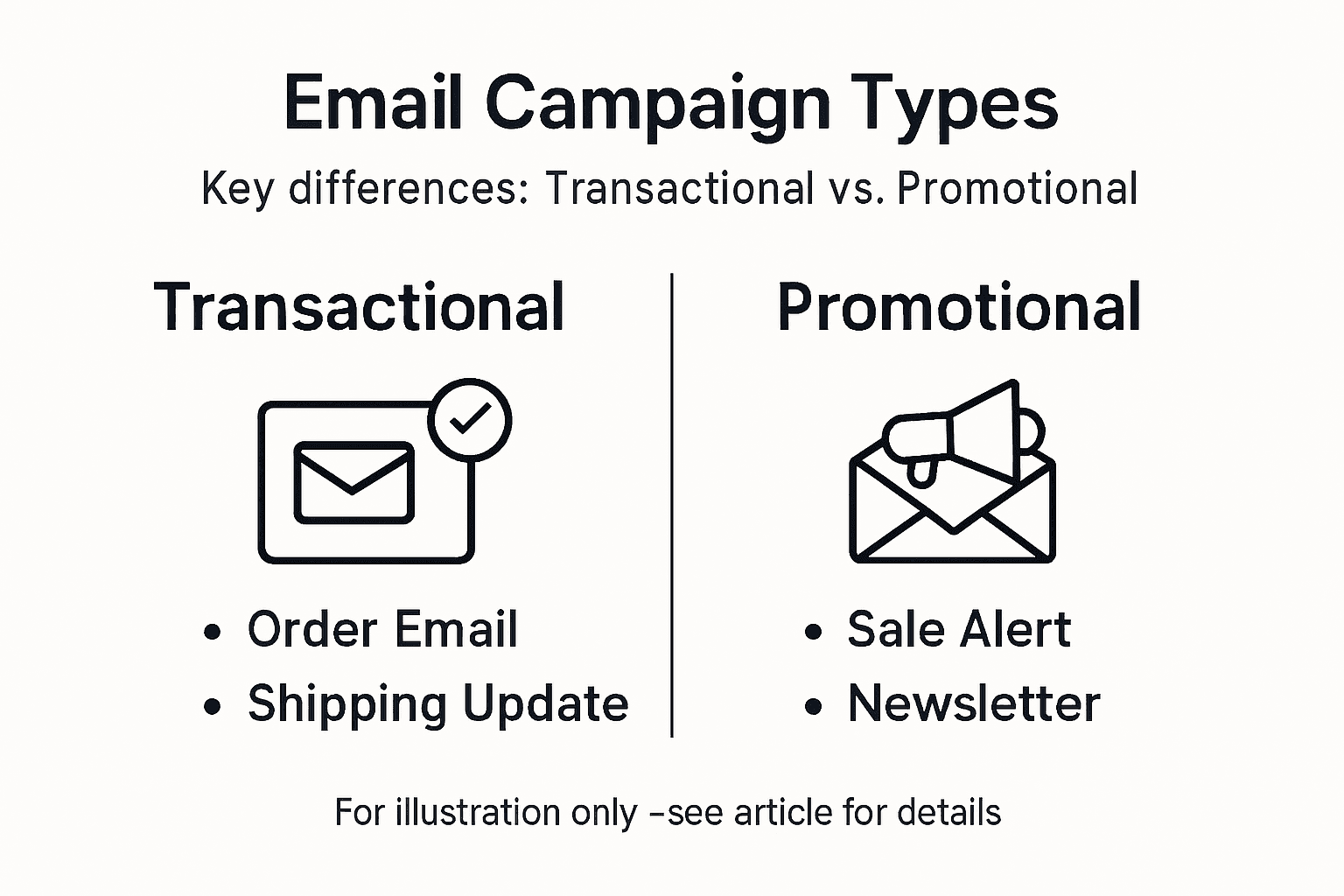
Email marketing encompasses two fundamental campaign types with distinct purposes and characteristics: transactional and promotional emails. Transactional emails are automated messages triggered by specific customer actions, serving a primarily functional communication purpose that goes beyond traditional marketing approaches.
Transactional emails include critical communications like order confirmations, shipping notifications, password resets, and account updates. These messages are typically expected and welcomed by customers, featuring high open rates because they contain essential information directly related to a specific user interaction. Unlike promotional emails, transactional messages are legally required to prioritize informational content over marketing messaging, making them a crucial touchpoint in customer communication.

Promotional emails, by contrast, are designed specifically to drive marketing objectives. These campaigns aim to generate sales, increase brand awareness, and encourage customer engagement through targeted offers, product announcements, and special promotions. Promotional marketing strategies leverage these emails to nurture leads, re-engage dormant customers, and create compelling narratives that motivate purchasing decisions. Successful promotional campaigns blend persuasive copywriting, strategic timing, and personalized content to maximize their impact.
Pro tip: Develop a balanced email strategy that integrates both transactional and promotional emails, ensuring each message provides genuine value to your recipients.
Here’s a comparison of transactional and promotional email campaigns:
| Attribute | Transactional Emails | Promotional Emails |
|---|---|---|
| Main Purpose | Deliver important user-specific information | Drive sales and encourage engagement |
| Trigger | Customer actions (e.g., purchase, reset) | Marketing schedule or campaign intent |
| Typical Content | Order confirmations, notifications | Offers, announcements, special deals |
| Legal Requirements | Must prioritize non-marketing content | Must include clear opt-out option |
| Typical Open Rate | Very high (critical info) | Variable, often lower than transactional |
| Customer Perception | Expected, trusted communication | Can be seen as intrusive if irrelevant |
Automated Drip and Nurture Campaigns Explained
Automated drip campaigns represent a sophisticated email marketing strategy designed to deliver targeted, timely messages that guide potential customers through their buying journey. Drip marketing strategies enable businesses to create personalized communication sequences that automatically respond to specific customer behaviors and interactions.
These campaigns consist of a carefully planned series of pre-written emails sent at predetermined intervals or triggered by specific user actions. For instance, a typical drip campaign might begin when a potential customer downloads a resource, signs up for a newsletter, or abandons a shopping cart. Each subsequent email is strategically crafted to provide relevant information, address potential concerns, and gently nudge the recipient toward a desired action – whether that’s completing a purchase, scheduling a consultation, or engaging more deeply with the brand.
Nurture campaigns take a more holistic approach to customer relationship management. Unlike traditional marketing communications, these automated sequences focus on building trust, providing value, and establishing long-term connections. Drip marketing communication allows businesses to maintain consistent engagement by delivering educational content, sharing industry insights, and demonstrating expertise without overwhelming recipients. The key is creating a seamless, intelligent communication flow that adapts to individual customer preferences and stages of the buying process.
Pro tip: Map out your entire customer journey before designing drip campaigns, identifying key touchpoints and creating content that addresses specific needs at each stage of the relationship.
Segmentation, Personalization, and Timing Strategies
Email marketing effectiveness fundamentally depends on understanding and implementing sophisticated targeting techniques that transform generic communications into precision-driven interactions. Email personalization strategies enable businesses to move beyond one-size-fits-all messaging, creating deeply resonant connections with individual recipients.
Audience segmentation represents the foundational strategy for targeted email campaigns. Marketers can divide their email lists into distinct groups based on multiple criteria, including demographic information, past purchase behavior, engagement history, and specific interests. By breaking down broad audiences into more granular segments, businesses can craft messages that speak directly to each group’s unique needs, preferences, and pain points. For example, a clothing retailer might create different email campaigns for professional women, athletic enthusiasts, and budget-conscious shoppers, ensuring that each segment receives content most relevant to their specific lifestyle and purchasing motivations.
Timing and personalization work hand in hand to maximize email campaign performance. Advanced marketing personalization goes beyond simply inserting a recipient’s name, instead creating intelligent, behavior-triggered communications that arrive precisely when they are most likely to generate engagement. Modern email marketing tools can analyze individual user interactions, determining optimal send times based on when each recipient is most likely to open, read, and act on an email. This nuanced approach transforms email from a broadcast medium into a sophisticated, adaptive communication channel that feels individually crafted for each subscriber.
Pro tip: Create a detailed customer persona matrix that maps out specific segments, their communication preferences, and potential trigger points to develop hyper-targeted email strategies.
This summary highlights key advanced strategies for greater email marketing success:
| Strategy | Description | Business Impact |
|---|---|---|
| Segmentation | Divide lists by demographics, behavior | Higher relevancy, more conversions |
| Personalization | Tailor content to each recipient | Greater engagement, brand loyalty |
| Intelligent Timing | Send messages when users are most active | Improved open and click rates |
| Automated Drip Flows | Timely, sequenced messages | Streamlined nurturing, sales growth |
Common Mistakes When Creating Email Campaigns
Email marketing demands precision and strategic thinking to avoid critical errors that can undermine campaign effectiveness. Common email communication mistakes can significantly reduce engagement, damage brand credibility, and ultimately decrease conversion rates.
One of the most pervasive mistakes marketers make is failing to craft compelling subject lines that genuinely capture recipient attention. Vague, generic, or overly complicated subject lines lead to decreased open rates, causing potentially valuable communications to be immediately deleted or ignored. Equally problematic is sending emails to broad, undifferentiated audiences without proper segmentation. Businesses often mistakenly broadcast identical messages to entire email lists, ignoring individual customer preferences, behaviors, and specific interests that drive meaningful engagement.
Technical and linguistic errors can also critically undermine email campaign credibility. Email communication etiquette emphasizes the importance of meticulous proofreading, correct grammar, and professional tone. Spelling mistakes, inappropriate capitalization, unclear calls to action, and unprofessional language can instantly erode recipient trust. Moreover, marketers frequently overlook the importance of mobile optimization, creating emails that display poorly on smartphones and tablets – a significant oversight given that over 60% of emails are first opened on mobile devices.
Pro tip: Implement a rigorous three-step review process for every email campaign, including content accuracy, design responsiveness, and audience segmentation validation.
Master Your Email Campaigns to Boost Sales and Customer Loyalty
Understanding the different types of email campaigns is essential for any business looking to increase sales and strengthen customer relationships. Whether you are struggling with low open rates on promotional emails or want to leverage automated drip campaigns to nurture leads, the key lies in mastering segmentation, personalization, and timing. Many businesses face the challenge of creating consistent, compelling email sequences that act as a silent sales machine working around the clock without needing active effort. The good news is you do not have to figure this out alone.
At emailedgar.com you can access expert guidance that helps you build and maintain targeted email lists, craft high-converting automated workflows, and fine-tune your messaging for maximum engagement. Imagine transforming your email strategy to deliver timely transactional updates and persuasive promotional offers that your audience actually anticipates. With proven frameworks and coaching tailored to your business needs, you can stop wasting resources on generic blasts and start seeing measurable growth.
Take control of your email marketing success today.
Explore how emailedgar.com turns complex email marketing concepts into actionable strategies. Visit now to unlock free resources, real client success stories, and offers that will help you launch your own automated drip campaigns designed to drive revenue. Don’t wait to convert your email list into your most powerful sales tool. Start your transformation at emailedgar.com.
Frequently Asked Questions
What are the different types of email campaigns?
Email campaigns primarily fall into two categories: transactional and promotional emails. Transactional emails are triggered by user actions and deliver necessary information, while promotional emails aim to drive sales and engagement through targeted offers and announcements.
How can automated drip campaigns enhance email marketing?
Automated drip campaigns deliver a series of targeted messages that guide customers through their buying journey. They are designed to respond to specific user actions, providing relevant content gradually to nurture leads and drive conversions.
Why is email segmentation important for effective campaigns?
Segmentation allows marketers to divide their email list into specific groups based on demographics, purchase behavior, and interests. This enables more personalized content delivery, leading to higher engagement and conversion rates as messages are tailored to the unique needs of each audience segment.
What common mistakes should be avoided when creating email campaigns?
Common mistakes include using vague subject lines, failing to segment audiences, overlooking proofreading for technical errors, and not optimizing emails for mobile devices. Avoiding these pitfalls can significantly enhance the overall effectiveness of email campaigns.