

Bold strategies drive success in American businesses, yet nearly 78 percent of owners still struggle to convert leads through email. While social media and SMS vie for attention, email continues to offer the strongest potential for meaningful customer relationships and reliable sales growth. This guide uncovers the most effective automated email marketing tactics, revealing how modern personalization, smart segmentation, and trust-building can transform engagement and conversion for small business owners and digital marketers.
Table of Contents
- What Makes Email Convert in 2026
- Modern Personalization and Segmentation Advances
- Automation and 24/7 Sales Enablement
- Comparing Email to Social and SMS Channels
- Legal, Privacy, and Deliverability Requirements
- Common Email Marketing Pitfalls to Avoid
Key Takeaways
| Point | Details |
|---|---|
| Effective Email Marketing | Hyper-personalization and strategic segmentation are crucial for engaging customers and improving conversion rates. |
| Building Trust | Marketers must focus on authenticity and deliver value, fostering relationships instead of merely pushing sales. |
| Automation’s Role | Leveraging AI-driven automation enhances continuous engagement and optimizes outreach strategies in real time. |
| Legal Compliance | Adhering to global privacy laws and maintaining deliverability through good practices are essential for successful email campaigns. |
What Makes Email Convert in 2026
Email marketing continues to prove its effectiveness, with global email usage reaching unprecedented levels in 2026. Despite the rise of multiple communication platforms, email remains the most reliable channel for direct customer engagement and conversion.
The key to successful email conversion in 2026 revolves around three critical strategies: hyper-personalization, strategic segmentation, and trust-building. Marketers must move beyond generic broadcasts and create highly targeted content that speaks directly to individual recipient needs. This means leveraging advanced data analytics and AI to understand customer preferences, behaviors, and potential pain points.
Trust and authenticity have become paramount in email marketing. Inbox providers like Gmail and Apple Mail now act as stringent gatekeepers, making sender reputation more important than ever. Successful email campaigns require clear subject lines, human-centered messaging, and content that provides genuine value. Marketers must focus on building relationships rather than simply pushing sales messages.
Pro tip: Implement a rigorous email list cleaning process every six months to maintain high deliverability rates and preserve your sender reputation.
Modern Personalization and Segmentation Advances
Email marketing has evolved dramatically, with advanced segmentation techniques transforming customer engagement in 2026. Modern marketers now leverage sophisticated data analysis and machine learning to create highly targeted, contextually relevant communication strategies that go far beyond traditional demographic targeting.
The core of contemporary email personalization lies in understanding customer behaviors and creating dynamic content experiences. Marketers now segment audiences across multiple dimensions – including lifecycle stage, engagement history, purchase behavior, and real-time interactions. Machine learning algorithms enable predictive personalization, allowing emails to adapt dynamically based on individual user preferences, browsing history, and predicted future needs.

Privacy and ethical data use remain paramount in these advanced personalization strategies. Successful marketers balance technical sophistication with transparent data practices, ensuring that personalization feels helpful rather than invasive. This means providing clear opt-in mechanisms, giving users granular control over their data, and demonstrating tangible value in exchange for personal information.
Pro tip: Create a comprehensive preference center that allows subscribers to self-segment and control their email experience, increasing both engagement and trust.
Automation and 24/7 Sales Enablement
The future of sales is being reshaped by autonomous AI agents driving continuous engagement, transforming how businesses approach customer interactions and lead management. These advanced systems operate around the clock, eliminating traditional time constraints and creating a seamless sales ecosystem that responds instantaneously to potential customer needs.
Modern sales automation goes beyond simple email scheduling and repetitive tasks. Intelligent AI-driven platforms now analyze complex customer data, predict buying behaviors, and create personalized outreach strategies that adapt in real time. These systems can intelligently segment audiences, craft contextually relevant messaging, and even predict the optimal timing for sales communications based on individual customer profiles.
The most sophisticated automation tools integrate multiple communication channels, creating a unified approach to customer engagement. They track interactions across email, social media, and web platforms, building comprehensive customer journey maps that enable more nuanced and effective sales strategies. By removing manual intervention, these systems dramatically reduce response times and increase the probability of successful conversions.
Pro tip: Implement a robust testing protocol for your AI sales automation tools, regularly reviewing performance metrics and adjusting algorithms to maintain human-like communication quality and relevance.
Comparing Email to Social and SMS Channels
Modern digital marketing demands a nuanced understanding of communication channels, and email continues to outperform competing platforms in critical performance metrics. While social media and SMS offer unique engagement opportunities, email remains the most sophisticated and financially impactful marketing tool for businesses seeking substantial returns.
Email marketing distinguishes itself through superior personalization capabilities and targeted messaging. Unlike social media’s broad-reach approach, email allows for granular audience segmentation, allowing businesses to craft highly specific communications that resonate directly with individual customer preferences. SMS provides immediacy, but lacks the rich content and design flexibility that email platforms offer, making email the more versatile communication medium.
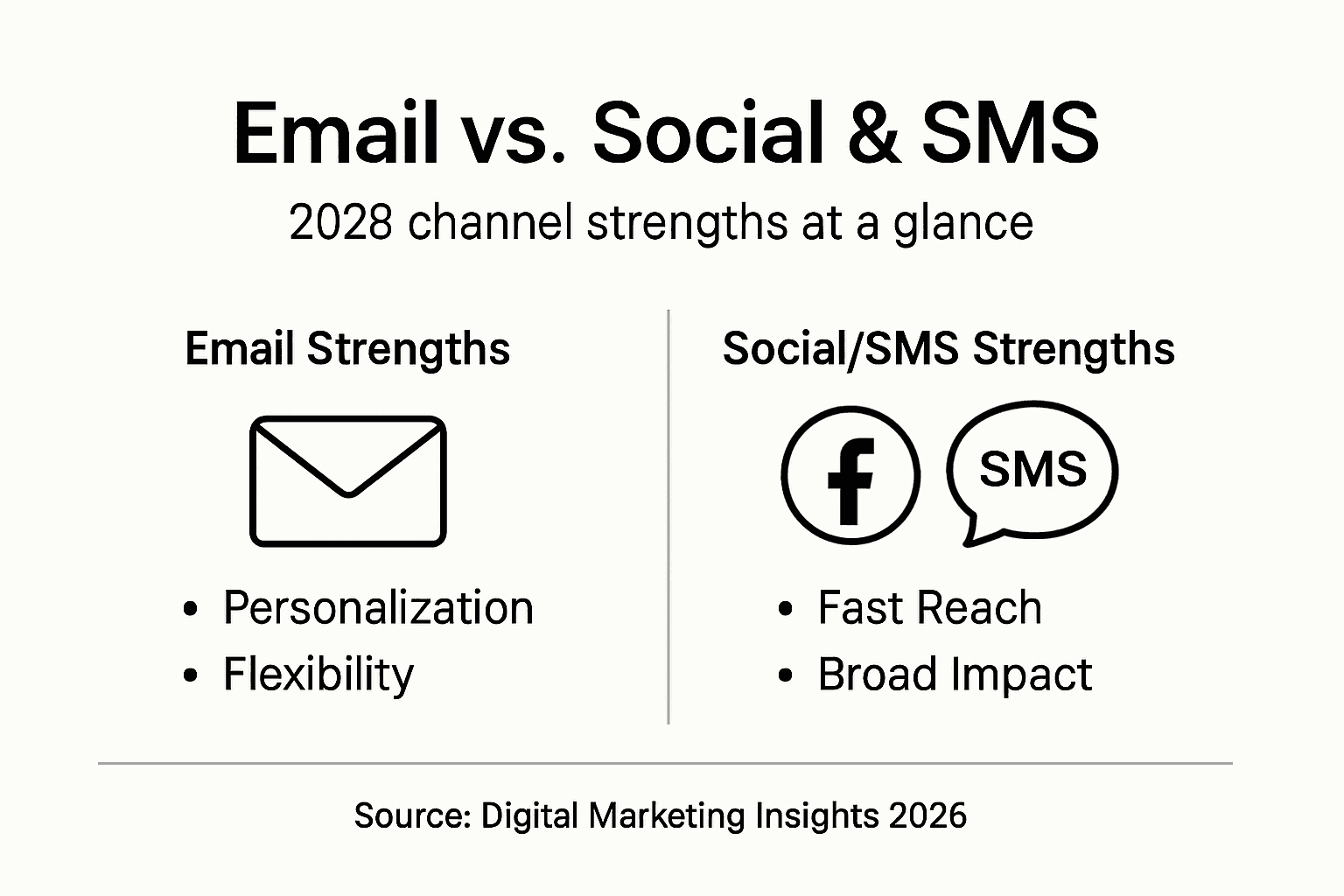
The strategic integration of multiple channels represents the future of digital marketing. Businesses are increasingly adopting omnichannel approaches that leverage the strengths of email, social media, and SMS. Email serves as the foundational communication channel, providing deep analytical insights, comprehensive tracking, and the highest return on investment. Social media and SMS complement email by offering additional touchpoints and real-time engagement opportunities.
Here’s a comparison of digital marketing channels in 2026:
| Channel | Personalization Depth | Content Flexibility | Engagement Speed | Business Impact |
|---|---|---|---|---|
| Advanced, AI-driven | Rich media, design | Variable, scheduled | High ROI, robust data | |
| Social Media | Broad, audience-wide | Visual, interactive | Instant, viral | Brand awareness boost |
| SMS | Direct, basic | Text only | Immediate | Fast notifications |
Pro tip: Develop a cross-channel communication strategy that uses each platform’s unique strengths, treating email as your primary relationship-building and conversion tool.
Legal, Privacy, and Deliverability Requirements
Email marketing in 2026 demands unprecedented attention to complex legal and privacy landscapes, where compliance is not just recommended but absolutely critical for successful digital communication strategies. The intersection of advanced artificial intelligence, stringent global regulations, and evolving consumer privacy expectations has transformed email marketing into a nuanced legal and technical discipline.
Modern email marketers must navigate a complex regulatory environment that includes multiple international privacy frameworks. Global standards like GDPR, CAN-SPAM, and emerging regional regulations require meticulous consent management, transparent data handling, and robust opt-out mechanisms. Businesses must implement comprehensive consent collection processes, maintain detailed records of subscriber agreements, and provide clear, accessible methods for users to control their data and communication preferences.
Deliverability has become a sophisticated science driven by intelligent spam filters and reputation management systems. Internet service providers and email platforms now employ advanced machine learning algorithms that evaluate sender reputation, engagement rates, and content quality. Successfully reaching subscriber inboxes requires a holistic approach that combines technical authentication protocols, consistent sending patterns, high-quality content, and proactive list management techniques.
Pro tip: Develop a comprehensive email compliance checklist that includes consent tracking, regular list cleaning, and periodic review of global privacy regulation updates.
Common Email Marketing Pitfalls to Avoid
Navigating the complex landscape of email marketing requires understanding and mitigating key risks that undermine deliverability and engagement. Success in 2026 demands a strategic approach that goes beyond basic communication tactics, focusing on precision, relevance, and technical sophistication.
Marketing teams frequently encounter critical errors that can devastate campaign performance. These include sending emails to unengaged recipients, neglecting list hygiene, using misleading subject lines, and failing to implement proper authentication protocols. Each of these mistakes can trigger spam filters, reduce sender reputation, and ultimately prevent messages from reaching intended audiences. Smart marketers must develop robust systems that continuously monitor and optimize email infrastructure.
The most significant pitfalls often stem from a lack of strategic planning and an overreliance on generic, unfiltered content. AI-generated materials, while powerful, require careful human oversight to maintain authenticity and relevance. Successful email marketing in 2026 demands a nuanced approach that balances technological capabilities with genuine human connection, ensuring that every communication feels personalized, valuable, and trustworthy.
Below is a summary of common email marketing pitfalls and their recommended prevention strategies:
| Pitfall | Consequence | Prevention Strategy |
|---|---|---|
| Unengaged recipients | Poor deliverability | Segment & remove inactive users |
| Misleading subject lines | Spam filter triggers | Honest, clear subject lines |
| Weak list hygiene | Damaged sender reputation | Routine list cleaning |
| Missing authentication protocols | Reduced inbox placement | Setup DKIM, SPF, DMARC records |
Pro tip: Implement a quarterly email list audit that removes inactive subscribers, validates email addresses, and reassesses segmentation strategies to maintain high engagement and deliverability rates.
Unlock the Full Potential of Email Marketing in 2026
The article highlights key challenges like maintaining high deliverability, creating hyper-personalized content, and leveraging automation to convert more customers consistently. If you struggle with keeping your email list clean, crafting targeted messages, or integrating AI-driven automation, you are not alone. The future of email marketing demands strategies that build trust, engage segmented audiences, and operate as a silent sales machine around the clock.
At emailedgar.com, we help businesses like yours overcome these exact hurdles by providing educational resources and coaching on how to build and maintain a powerful email list. Our approach aligns perfectly with the article’s advice on strategic segmentation, rigorous list management, and smart automation that drives continuous engagement. We empower you to turn your email marketing into a high-impact sales tool that works for you 24/7 without extra effort.
Are you ready to transform your email campaigns into your most reliable source of revenue? Take the first step now by exploring emailedgar.com and discovering proven strategies that meet today’s email marketing standards.
Start building your silent sales machine today and experience the difference of truly effective email communication.
Learn more about optimizing your email marketing and join a community of businesses raising their engagement and sales in 2026.
Frequently Asked Questions
How can hyper-personalization improve email conversion rates in 2026?
Hyper-personalization enhances email conversion rates by tailoring content to individual recipient preferences and behaviors. By utilizing advanced data analytics and AI, marketers can create targeted emails that resonate with recipient needs, leading to higher engagement and conversion.
What role does trust play in email marketing success?
Trust is crucial in email marketing, especially with stringent inbox provider regulations. Building relationships through authentic messaging and transparent data practices helps establish credibility, making recipients more likely to engage with emails and convert.
How does automation impact email marketing effectiveness?
Automation allows for continuous customer engagement and personalized outreach strategies, even outside traditional working hours. By analyzing customer data and interactions, automated systems can tailor messaging and improve response times, enhancing overall conversion rates.
What common pitfalls should marketers avoid in email campaigns?
Marketers should avoid pitfalls like targeting unengaged subscribers, using misleading subject lines, neglecting list hygiene, and missing authentication protocols. Each of these can harm deliverability and engagement, reducing the overall effectiveness of email marketing campaigns.