

Nearly every American small business owner knows the frustration of sending emails that seem to vanish into a void. With email marketing delivering an average of $36 for every dollar spent, missing out on effective strategies means leaving real money on the table. For American entrepreneurs and marketers who want to engage customers and spark more sales, understanding what makes email campaigns work can change the game completely.
Table of Contents
- Defining Email Marketing And Its Business Value
- Core Strategies And Automation Methods Explained
- Key Benefits: ROI, Reach, And Relationship Building
- Challenges, Pitfalls, And Legal Compliance Issues
- Comparing Email Marketing With Other Digital Channels
Key Takeaways
| Point | Details |
|---|---|
| Email Marketing Value | Email marketing drives direct communication, enabling targeted messaging that enhances sales and customer relationships. |
| Automation Advantages | Strategic automation in email marketing allows for personalized customer interactions, increasing engagement and conversion rates. |
| High ROI Potential | Email marketing yields approximately $36 for every dollar spent, making it an exceptionally cost-effective strategy. |
| Regulatory Compliance | Understanding legal requirements around consent and privacy is crucial to maintaining effective email marketing practices. |
Defining Email Marketing And Its Business Value
Email marketing represents a strategic digital communication method that enables businesses to connect directly with customers through targeted, personalized electronic messages. Unlike traditional advertising channels, this approach allows for precise audience segmentation and measurable engagement. Email marketing encompasses direct communication strategies designed to acquire, retain, and nurture customer relationships.
At its core, email marketing involves sending purposeful communications like newsletters, promotional offers, transactional updates, and personalized content to a consenting audience. The primary objectives include generating sales, building brand awareness, and maintaining continuous customer interaction. Businesses leverage sophisticated tools to track open rates, click-throughs, and conversion metrics, transforming email from a simple communication tool into a powerful sales and relationship-building platform.
The business value of email marketing extends far beyond traditional advertising methods. Research indicates that permission-based email campaigns create deeper emotional and cognitive engagement with customers. By delivering relevant content directly to an individual’s inbox, companies can establish trust, demonstrate expertise, and guide potential buyers through their purchasing journey. Targeted email interactions significantly increase customer awareness and conversion potential, making it a cost-effective strategy for businesses of all sizes.
Pro Tip: Start building your email list immediately by offering genuine value through lead magnets like exclusive content, discounts, or actionable resources that solve your audience’s specific problems.
Core Strategies And Automation Methods Explained
Email marketing automation represents a sophisticated approach to customer communication that transforms traditional outreach into a intelligent, responsive system. Effective automation strategies focus on precise customer lifecycle management by delivering personalized messages triggered by specific user behaviors and interactions. This dynamic method allows businesses to create targeted communication pathways that adapt in real-time to individual customer journeys.
The core of successful email marketing automation lies in strategic segmentation and intelligent trigger mechanisms. Businesses can design complex workflows that automatically respond to customer actions such as website visits, purchase history, engagement levels, and demographic characteristics. These automated sequences enable companies to deliver highly relevant content at optimal moments, significantly increasing the likelihood of conversion and customer retention. Sophisticated automation tools track user interactions, allowing marketers to craft nuanced communication strategies that feel personal and timely.
Advanced automation methods go beyond simple scheduled messages. Modern email marketing platforms provide intricate options for creating branching logic, where different actions trigger unique response sequences. For instance, a customer who downloads a specific resource might receive a tailored follow-up series distinct from someone who abandoned a shopping cart. These intelligent systems analyze user behavior, preferences, and engagement patterns to continuously refine and optimize communication strategies, ensuring that each message feels uniquely crafted for the recipient.
Pro Tip: Start small by creating two to three targeted automation workflows focusing on your most critical customer journey stages, and progressively expand your automation complexity as you gather performance data.
Here’s a concise summary of key email marketing automation techniques and their business impact:
| Automation Approach | Trigger Mechanism | Typical Outcome |
|---|---|---|
| Welcome Series | New subscriber | Higher engagement, strong first impression |
| Abandoned Cart Reminder | Cart abandonment | Increased recovery of lost sales |
| Re-engagement Campaigns | Inactivity or low opens | Retained subscribers, reduced churn |
| Personalized Offers | Past purchase history | Improved conversion and loyalty |
Key Benefits: ROI, Reach, And Relationship Building
Return on Investment stands as the most compelling argument for email marketing, with businesses experiencing remarkable financial outcomes. Email marketing consistently delivers exceptional economic value, generating an average of $36 for every single dollar invested. This extraordinary return makes it one of the most cost-effective digital marketing strategies available to businesses of all sizes, offering unprecedented potential for scaling revenue without proportional increases in marketing expenditure.

The reach of email marketing extends far beyond traditional advertising channels, providing businesses with a direct, personalized communication pathway to their target audience. Unlike social media platforms or paid advertising that rely on algorithmic visibility, email marketing ensures your message lands directly in a customer’s inbox. This direct access allows for precise audience segmentation, enabling businesses to craft highly targeted messages that speak directly to specific customer interests, behaviors, and demographics. The ability to personalize content dramatically increases engagement rates, conversion potential, and overall marketing effectiveness.
Relationship building emerges as another critical benefit of strategic email marketing. By delivering consistent, valuable content, businesses can transform transactional interactions into meaningful connections. Email provides a unique opportunity to nurture customer relationships through educational content, exclusive insights, and personalized communication that feels intimate and purposeful. This ongoing dialogue helps build trust, establish brand authority, and create long-term customer loyalty that transcends single-transaction interactions. The cumulative effect is a robust, engaged customer base that views your brand as a trusted resource rather than just another marketing channel.
Pro Tip: Segment your email list based on customer behavior and preferences to create hyper-targeted campaigns that feel personally crafted for each recipient, dramatically improving engagement and conversion rates.
Challenges, Pitfalls, And Legal Compliance Issues
Email marketing navigates a complex landscape of legal and technical challenges that can potentially undermine even the most well-intentioned campaigns. Global legal frameworks impose strict regulations designed to protect consumer privacy and ensure ethical marketing practices, creating a minefield of potential compliance risks for businesses. Understanding these regulations is crucial, as non-compliance can result in substantial financial penalties, damaged reputation, and significant disruptions to marketing operations.
Technical challenges present another critical dimension of email marketing complexity. Spam filters have become increasingly sophisticated, making it challenging to ensure message deliverability. Businesses must carefully craft their email content to avoid trigger words, maintain appropriate text-to-image ratios, and manage sender reputation. Additionally, email list management requires constant vigilance – dealing with bounce rates, managing unsubscribe requests, and maintaining list hygiene are ongoing responsibilities that demand consistent attention and strategic approach.
Consent and privacy represent the most critical legal considerations in modern email marketing. Businesses must implement robust consent management systems that go beyond simple checkbox mechanisms. This involves obtaining explicit, verifiable permission from recipients, providing clear information about how their data will be used, and maintaining transparent communication channels. Different jurisdictions have varying requirements, with regulations like GDPR in Europe, CAN-SPAM in the United States, and CASL in Canada each imposing unique compliance standards that require nuanced understanding and implementation.
Pro Tip: Develop a comprehensive consent management protocol that includes double opt-in processes, clear privacy policy explanations, and easy unsubscribe mechanisms to demonstrate your commitment to ethical communication.
Comparing Email Marketing With Other Digital Channels
Digital marketing channels each offer unique strengths, but comparative analyses reveal nuanced performance differences across various platforms. Email marketing distinguishes itself through targeted communication and cost-effectiveness, while other channels like social media and search engine optimization excel in different areas. Understanding these distinctions helps businesses design more strategic, integrated marketing approaches that leverage the unique advantages of each channel.
When examining conversion potential, email marketing demonstrates remarkable efficiency compared to alternative digital channels. Unlike social media platforms that prioritize broad visibility, email enables precise audience targeting and personalized messaging. Paid advertising generates wide exposure but typically produces lower engagement rates and significantly higher acquisition costs. Email marketing consistently outperforms these channels by delivering direct, permission-based communication that speaks directly to individual customer preferences and behaviors, resulting in higher conversion rates and more meaningful customer interactions.
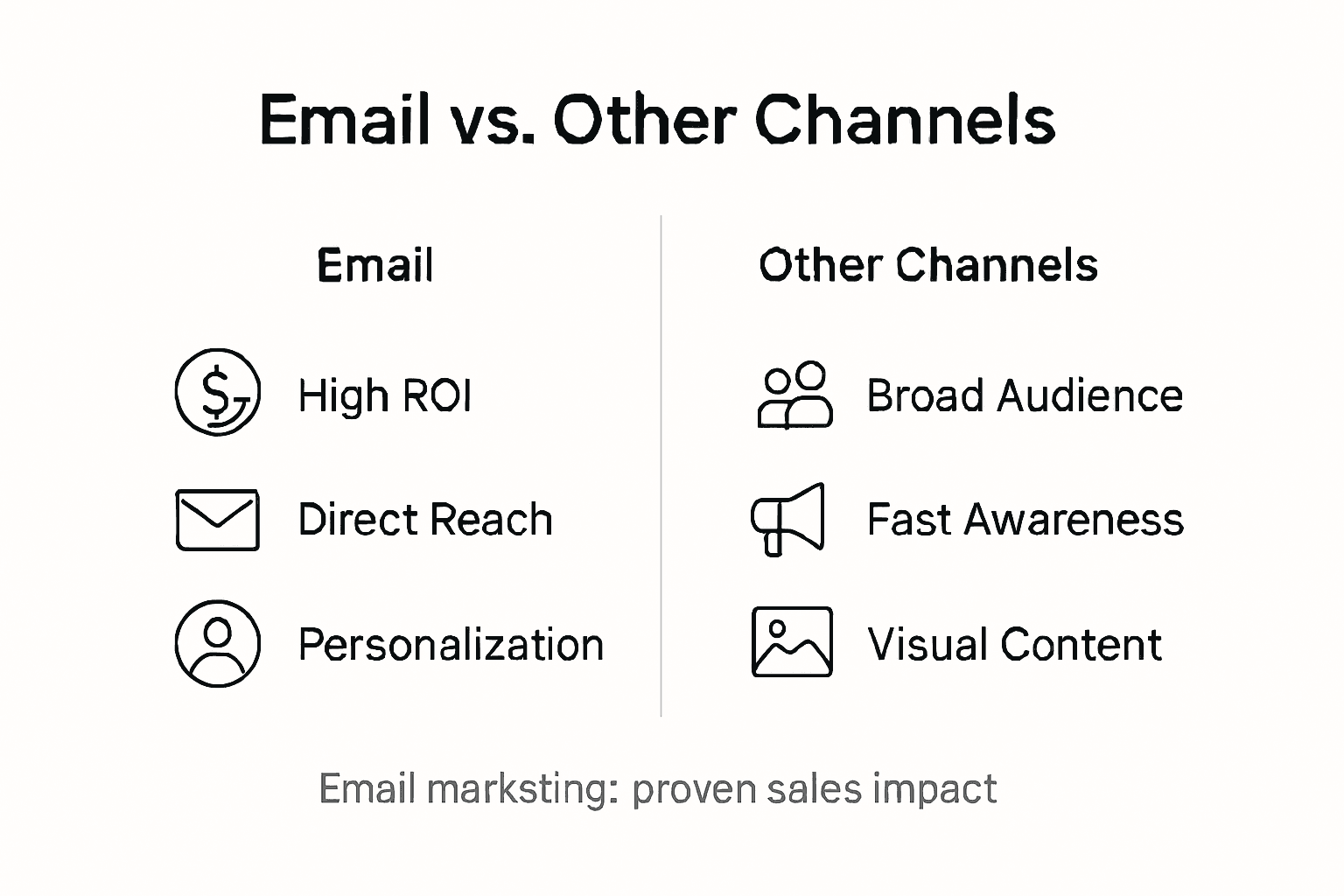
Multi-channel marketing strategies emerge as the most sophisticated approach to digital communication. While email marketing provides exceptional return on investment and direct customer relationship management, social media platforms offer unparalleled brand awareness and community building. The most successful businesses integrate these channels strategically, using email for nurturing leads and driving conversions, while simultaneously leveraging social media for broader brand storytelling and audience engagement. This synergistic approach allows companies to create comprehensive marketing ecosystems that maximize reach, engagement, and ultimately, revenue generation.
Pro Tip: Design an integrated marketing strategy that uses each digital channel for its strongest purpose – email for conversion, social media for awareness, and search marketing for discovery.
This table compares the strengths of major digital marketing channels for business growth:
| Channel | Main Strength | Typical Use Case | Cost Efficiency |
|---|---|---|---|
| Email Marketing | Conversion & loyalty | Direct sales, nurture leads | Very high ($36 ROI) |
| Social Media | Brand awareness | Broad audience engagement | Moderate |
| Paid Ads | Immediate visibility | New product launches, retargeting | Variable |
| SEO | Long-term discovery | Organic website traffic | High over time |
Unlock the Full Potential of Email Marketing for Your Business
The article highlights the challenge many businesses face when trying to build and maintain a high-quality email list while delivering automated, personalized communication that drives sales and engagement around the clock. If you struggle with turning email marketing into a reliable “silent sales machine” that nurtures leads and boosts conversions without constant manual effort you are not alone. Achieving consistent results demands mastering automation workflows, precise segmentation, and proven content strategies that engage customers deeply and build trust over time.
At emailedgar.com, we understand these challenges and offer a comprehensive platform designed to help you overcome them. Our resources guide you step-by-step on building your list from genuine interested contacts, crafting automation sequences that respond intelligently to customer behaviors, and maintaining compliance with legal standards to protect your brand. Experience how automated email marketing can increase your ROI while freeing you to focus on growing your business rather than chasing every sale.
Ready to transform your email marketing and start seeing real sales impact now
Visit emailedgar.com today to learn more about proven email marketing strategies or grab your exclusive copy of our email marketing book. Take the first step toward a powerful, automated system that works for you 24/7 and turns your email list into your most valuable sales asset.
Frequently Asked Questions
What is email marketing and why is it valuable for businesses?
Email marketing is a strategic digital communication method that allows businesses to connect directly with customers through targeted, personalized messages. It is valuable because it generates a high return on investment (ROI), typically $36 for every dollar spent, and fosters meaningful customer relationships through direct and personalized communication.
How can businesses improve their email marketing strategy?
Businesses can enhance their email marketing strategy by implementing segmentation techniques to target specific audiences with personalized content. Additionally, utilizing automation for customer lifecycle management and crafting valuable content can further increase engagement and conversion rates.
What role does automation play in email marketing?
Automation in email marketing allows businesses to send targeted, personalized messages based on user behavior and engagement. This leads to more efficient communication, as automated workflows can respond dynamically to actions such as website visits or email interactions, increasing the chances of conversion.
What are the main differences between email marketing and social media marketing?
Email marketing provides direct, targeted communication to a specific audience, resulting in higher conversion rates. In contrast, social media marketing focuses on broad audience engagement and brand awareness but may have lower conversion efficiency. Utilizing both strategies together can create a comprehensive marketing approach.