

Over ninety percent of American consumers check their email daily, yet many small businesses still struggle to turn those inbox visits into sales. For the typical American entrepreneur or marketer, that means missed opportunities piling up with every unopened message. Knowing how an automated email funnel works not only simplifies your tasks but actually guides customers from curiosity to long-term loyalty, giving every campaign a clear plan to follow and measure.
Table of Contents
- Defining An Email Funnel And Its Key Roles
- Types Of Email Funnels For Business Growth
- How Automated Email Funnels Operate
- Common Pitfalls In Email Funnel Strategy
- Comparing Email Funnels And Other Channels
Key Takeaways
| Point | Details |
|---|---|
| Email Funnels Are Structured | Email funnels guide subscribers through stages from awareness to retention, requiring tailored strategies for each phase. |
| Types of Funnels Exist for Different Goals | Businesses can customize various email funnel types, such as lead generation, onboarding, and sales conversion, to meet specific objectives. |
| Automation Enhances Efficiency | Automated email funnels utilize segmentation and personalized messaging to efficiently guide users without manual intervention. |
| Common Pitfalls Should Be Avoided | Key mistakes like inconsistent messaging and poor audience segmentation can hinder email funnel performance, necessitating ongoing optimization. |
Defining an Email Funnel and Its Key Roles
An email funnel is a strategic communication framework designed to transform interested subscribers into loyal customers through targeted, progressive messaging. Marketing strategists use this systematic approach to guide potential buyers through a carefully structured journey that addresses their evolving needs and challenges.
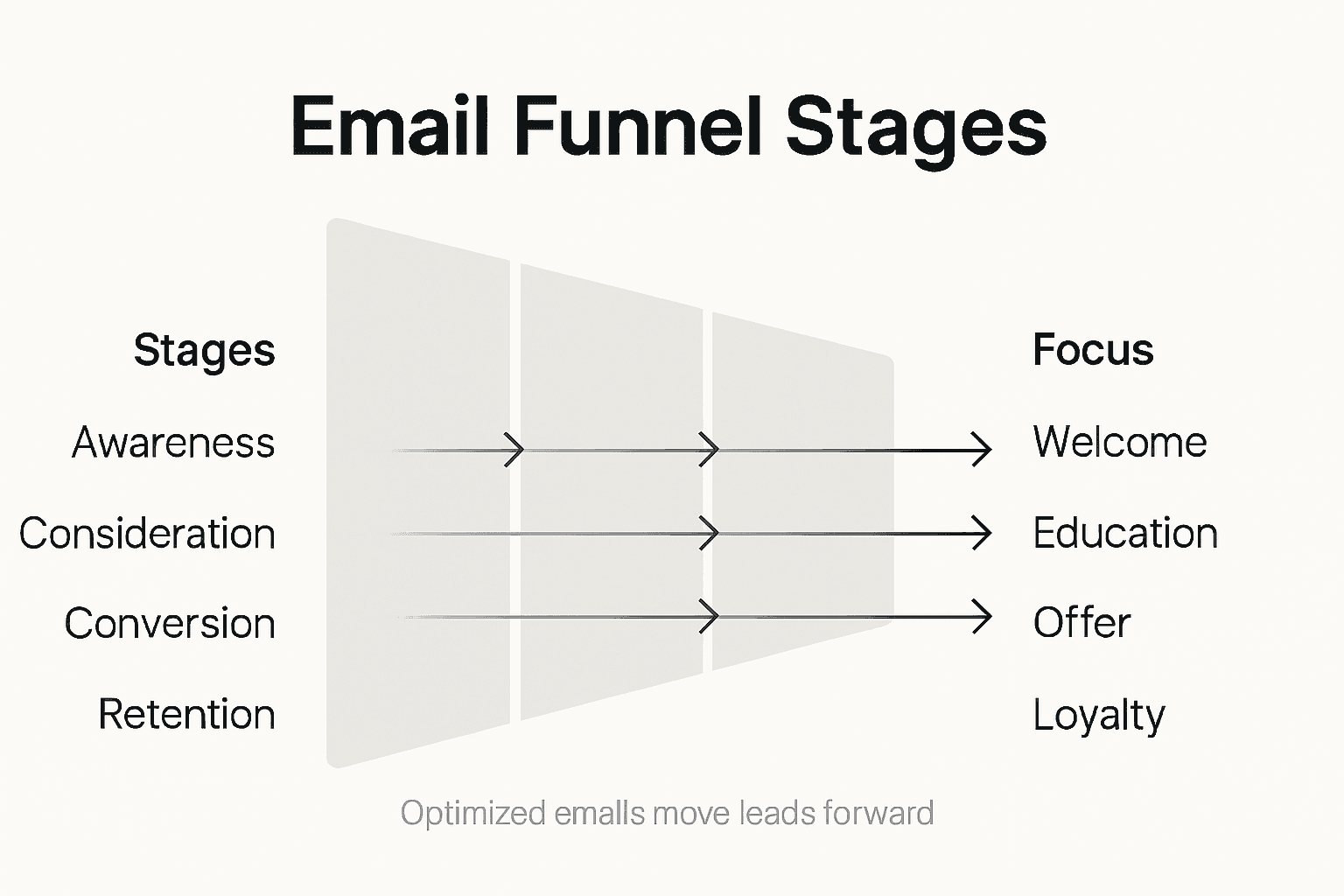
The email marketing funnel typically consists of multiple interconnected stages that map the customer’s progression from initial awareness to final conversion. These stages usually include:
- Awareness Stage: Introducing your brand and value proposition
- Consideration Stage: Providing deeper insights and solving specific problems
- Conversion Stage: Presenting compelling offers and clear calls to action
- Retention Stage: Maintaining engagement and encouraging repeat business
Each stage requires a unique communication strategy tailored to the subscriber’s current mindset and information requirements. By delivering personalized, relevant content at precisely the right moment, businesses can build trust, demonstrate expertise, and gently guide potential customers toward making a purchase decision.
Here is a summary of funnel stages and their core objectives:
| Funnel Stage | Main Objective | Typical Email Content | Desired Outcome |
|---|---|---|---|
| Awareness | Introduce brand | Welcome and brand intro | Subscriber engagement |
| Consideration | Educate and build trust | Insightful guides, solutions | Interest and knowledge |
| Conversion | Motivate purchase | Offers and calls to action | Lead conversion |
| Retention | Sustain customer relationship | Loyalty incentives, follow-ups | Repeat purchases, loyalty |
Pro tip: Create distinct email sequences for each funnel stage, ensuring your messaging becomes progressively more targeted and conversion-focused as subscribers move through their journey.
Types of Email Funnels for Business Growth
Email funnels are versatile marketing frameworks that businesses can customize to achieve specific growth objectives. Different funnel types strategically target various customer lifecycle stages to maximize engagement and drive meaningful business results.
The most common types of email funnels include:
- Lead Generation Funnel: Designed to attract and capture potential customer contact information through compelling lead magnets
- Onboarding Funnel: Helps new subscribers or customers understand product value and navigate initial interactions
- Nurture Funnel: Builds relationships by providing educational content and establishing trust over time
- Sales Conversion Funnel: Focuses on moving qualified leads toward making a purchase through targeted promotional emails
- Retention and Upsell Funnel: Maintains customer relationships and encourages additional purchases from existing customers
Each funnel type requires a unique approach, tailoring email content, frequency, and messaging to match specific business goals and customer expectations. Successful implementation demands understanding your audience’s needs, pain points, and motivations across different engagement stages.
Pro tip: Map out your customer journey in advance and create email sequences that anticipate and address potential questions or objections at each stage of the funnel.
How Automated Email Funnels Operate
Automated email funnels represent a sophisticated marketing technology that streamlines communication by delivering precisely targeted messages without constant manual intervention. Marketing automation software enables these intelligent communication pathways that dynamically adapt to individual user behaviors and engagement levels.
The core operational mechanism of automated email funnels involves several critical components:
- Trigger Events: Specific user actions that initiate automated email sequences
- Segmentation: Categorizing subscribers based on demographics, behaviors, and interactions
- Personalization: Customizing email content to match individual subscriber profiles
- Behavioral Tracking: Monitoring subscriber interactions to refine future communications
- Automated Workflows: Predefined email sequences that progress based on subscriber responses
These funnels work by creating intelligent, responsive communication channels that guide subscribers through a carefully designed journey. Each email is strategically timed and crafted to address the recipient’s current stage of engagement, delivering relevant content that moves them closer to conversion.

Pro tip: Set up comprehensive tracking mechanisms that capture granular subscriber interactions, allowing you to continuously refine and optimize your automated email sequences for maximum effectiveness.
Common Pitfalls in Email Funnel Strategy
Email marketing strategies often fail due to critical strategic missteps that can significantly undermine campaign effectiveness. Marketers frequently encounter predictable challenges that can derail their email funnel performance by overlooking key strategic considerations.
The most prevalent email funnel pitfalls include:
- Inconsistent Messaging: Sending conflicting or confusing communication that dilutes brand credibility
- Poor Audience Segmentation: Treating all subscribers identically instead of personalizing content
- Over-Emailing: Bombarding subscribers with excessive communications that lead to list fatigue
- Lack of Clear Goals: Developing email sequences without defined key performance indicators
- Insufficient Analytics Tracking: Failing to monitor and adapt based on subscriber engagement metrics
Successful email funnel strategies require a nuanced understanding of subscriber behavior, meticulous planning, and continuous optimization. Businesses must develop adaptive communication frameworks that respond dynamically to individual user interactions, ensuring each email delivers genuine value and moves subscribers closer to conversion.
Pro tip: Implement a quarterly review process that critically analyzes your email funnel performance, tracking key metrics like open rates, click-through rates, and conversion percentages to identify and quickly address potential strategic weaknesses.
Comparing Email Funnels and Other Channels
Digital marketing offers numerous channels for reaching potential customers, but email funnels stand out as a uniquely powerful communication strategy. Email marketing distinguishes itself through precise audience targeting and measurable engagement, providing businesses with a direct, personalized communication pathway that other channels cannot replicate.
Key differences between email funnels and alternative marketing channels include:
- SEO: Builds long-term organic visibility but lacks immediate interaction
- Social Media: Generates broad brand awareness with limited conversion potential
- PPC Advertising: Drives immediate traffic but requires continuous financial investment
- Email Funnels: Enables permission-based, personalized communication with measurable results
While each digital marketing channel serves a unique purpose, email funnels excel at nurturing relationships, delivering targeted content, and driving consistent conversions. Unlike broadcast channels that scatter messaging, email funnels create intimate, sequential interactions that guide subscribers through a carefully designed journey, transforming casual interest into committed customer relationships.
The table below compares email funnels to other major digital marketing channels:
| Channel | Strengths | Weaknesses | Measurement Capability |
|---|---|---|---|
| Email Funnels | Personalization, strong targeting | Requires list growth efforts | Highly measurable |
| SEO | Sustainable visibility | Slow impact, competitive | Indirect, gradual metrics |
| Social Media | Wide audience reach | Less direct conversions | Engagement metrics only |
| PPC Advertising | Immediate traffic | Ongoing ad costs | Direct spend-to-conversion |
Pro tip: Integrate email funnels with other marketing channels by using consistent messaging and cross-channel tracking to create a holistic, interconnected marketing ecosystem.
Unlock the True Power of Your Email Funnel Today
The article highlights critical challenges in creating effective email funnels such as inconsistent messaging, poor audience segmentation, and lack of automation. If you struggle with building a seamless, automated sequence that nurtures leads and drives sales without constant manual effort then you are not alone. Many business owners face these pain points while trying to convert awareness into loyal customers through well-crafted email communication. By mastering concepts like segmentation, automation triggers, and personalized messaging you can transform your email funnel into a silent sales machine working 24/7.
At emailedgar.com, we specialize in helping businesses just like yours overcome these exact hurdles. Our platform guides you step-by-step on growing and maintaining an engaged email list, automating personalized sequences, and delivering consistent brand messages that build trust and increase conversions. Whether you want to design compelling onboarding funnels or retention campaigns with ease you will find valuable coaching and proven strategies to scale your revenue through email marketing.
Ready to stop guessing and start converting? Explore how our digital marketing tools can make your email funnel smarter and more profitable.
Take control of your sales process with automated email funnels that work around the clock. Visit emailedgar.com to learn more and get started on your journey toward higher engagement and increased sales now.
Frequently Asked Questions
What is an email funnel?
An email funnel is a strategic communication framework that guides potential customers through a journey from initial awareness of your brand to making a purchase, using targeted messages tailored to their evolving needs.
How do I create an effective email funnel?
To create an effective email funnel, identify the key stages (awareness, consideration, conversion, retention) and develop tailored content for each stage. Utilize automation tools to streamline communication and ensure consistent engagement.
What types of email funnels can businesses use?
Businesses can use various email funnels, including lead generation, onboarding, nurture, sales conversion, and retention funnels. Each type targets specific goals and addresses different stages of the customer lifecycle.
What are common mistakes to avoid in email funnel strategies?
Common mistakes include inconsistent messaging, poor audience segmentation, over-emailing, lack of clear goals, and insufficient analytics tracking. These issues can undermine the effectiveness of email campaigns and reduce engagement.