

Over eighty percent of American small businesses rely on email marketing to engage buyers and drive steady sales. For owners and marketers worldwide, this isn’t just an American trend—automated emails deliver a personal touch without draining hours. The right strategy transforms basic campaigns into ongoing conversations that feel custom made. This guide unpacks how automation, segmentation, and smart content can help your business connect, convert, and grow without extra manual effort.
Table of Contents
- Defining Email’s Role In Sales Success
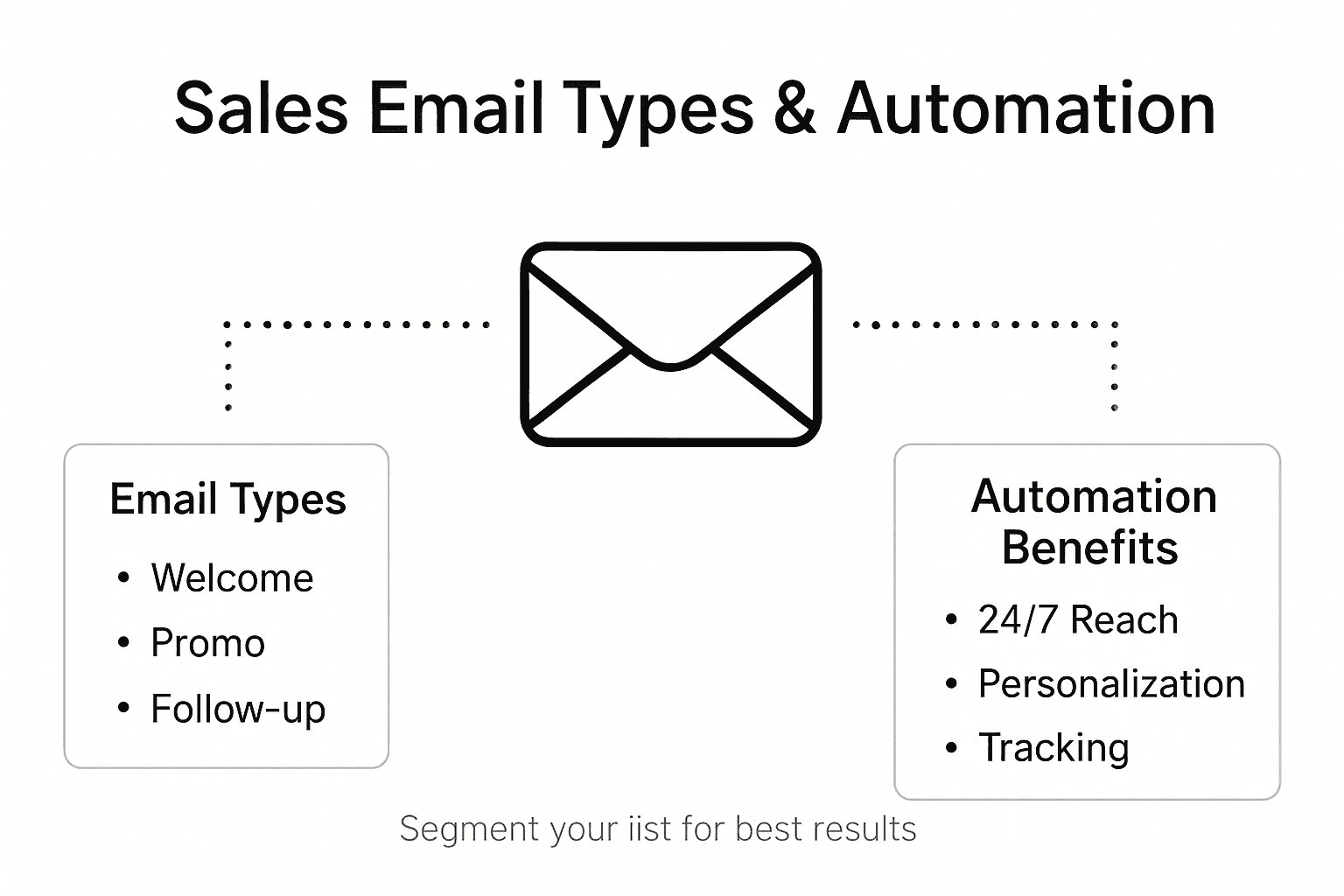
- Types Of Sales Emails And Their Purposes
- Automation Systems For 24/7 Engagement
- Building And Segmenting Sales Email Lists
- Common Email Marketing Mistakes To Avoid
Key Takeaways
| Point | Details |
|---|---|
| Email Marketing is Essential | It transforms customer engagement and drives sales growth through personalized communication. |
| Diverse Sales Email Types | Utilize various email types such as promotional, welcome, and nurture emails to achieve specific business objectives. |
| Leverage Automation | Automated email systems facilitate continuous engagement and timely interactions tailored to customer behavior. |
| Avoid Common Pitfalls | Focus on relevant content, avoid frequency fatigue, and ensure clear calls-to-action to maximize email marketing effectiveness. |
Defining Email’s Role in Sales Success
Email marketing represents a powerful, strategic communication channel that transforms how businesses connect with potential customers and drive sales growth. Unlike traditional marketing methods, email provides a direct, personalized pathway to engage audiences, build relationships with potential and existing customers, and generate valuable leads.
The effectiveness of email in sales success stems from its unique ability to deliver targeted, measurable communication. Businesses can segment audiences, track engagement metrics, and craft customized messages that resonate with specific customer groups. Modern email marketing goes far beyond simple promotional broadcasts – it’s a sophisticated tool for nurturing relationships, providing value, and guiding potential buyers through complex purchasing journeys.
Statistically, email marketing demonstrates remarkable potential across industries. Worldwide digital marketing strategies increasingly rely on email’s ability to promote products and services effectively, with factors like content quality, message frequency, and design playing critical roles in driving sales performance. Successful email campaigns focus on delivering genuine value, understanding customer needs, and creating compelling narratives that transform passive readers into active buyers.
Pro Tip: Design your email campaigns with a laser focus on providing genuine value to recipients, ensuring each message addresses a specific customer pain point or delivers actionable insights.
Types of Sales Emails and Their Purposes
Sales emails represent a nuanced communication strategy with multiple specialized types designed to achieve specific business objectives. Different sales email elements strategically influence consumer behavior, ranging from personalized newsletters to targeted promotional campaigns that drive engagement and conversions.
The primary categories of sales emails include:
- Promotional Emails: Direct marketing messages highlighting special offers, discounts, or time-sensitive deals
- Welcome Emails: Initial communication establishing relationship and brand connection with new subscribers
- Nurture Emails: Sequential messages designed to build trust and guide potential customers through purchasing decisions
- Re-engagement Emails: Targeted communications aimed at reactivating inactive customers or subscribers
- Recommendation Emails: Personalized suggestions based on customer preferences and previous interactions
Each email type serves a distinct purpose in the sales funnel, enabling businesses to create targeted, meaningful interactions that progressively move potential customers toward making a purchase. Successful email strategies carefully balance frequency, content relevance, and personalization to maintain subscriber interest and drive measurable sales outcomes.
Here’s a comparison of sales email types and their business objectives:
| Email Type | Primary Goal | Best Use Case |
|---|---|---|
| Promotional | Drive quick conversions | Announcing sales or limited deals |
| Welcome | Build initial trust | Onboarding new subscribers |
| Nurture | Guide purchase decisions | Educating prospects over time |
| Re-engagement | Reactivate interest | Bringing back inactive contacts |
| Recommendation | Increase cross-sells | Suggesting related products |
Pro Tip: Develop a comprehensive email segmentation strategy that allows you to customize messaging and offers based on specific customer characteristics, behaviors, and engagement levels.
Automation Systems for 24/7 Engagement
Email automation systems have revolutionized how businesses approach customer communication, enabling continuous customer engagement through sophisticated triggered workflows. These intelligent platforms transform traditional marketing approaches by creating dynamic, responsive communication channels that operate seamlessly without constant human intervention.
Key features of modern email automation systems include:
- Behavioral Triggered Emails: Automatically sent based on specific customer actions
- Lifecycle Stage Messaging: Customized communications matching customer journey phases
- Predictive Content Personalization: AI-driven recommendations tailored to individual preferences
- Real-Time Performance Tracking: Instant insights into email engagement and conversion metrics
- Segmentation Capabilities: Advanced audience division for hyper-targeted messaging
The true power of automation lies in its ability to create personalized, timely interactions that feel individually crafted yet operate at scale. By leveraging machine learning and advanced algorithms, these systems can predict customer needs, optimize send times, and continuously refine communication strategies to maximize engagement and sales potential.

Pro Tip: Implement a multi-step testing approach for your automation workflows, regularly analyzing performance metrics and incrementally refining triggers and content to improve conversion rates.
Building and Segmenting Sales Email Lists
Building an effective sales email list requires strategic planning and sophisticated segmentation techniques that go beyond simple contact collection. Effective segmentation of sales email lists is vital for personalizing communication and maximizing marketing ROI, transforming generic broadcasts into targeted, meaningful interactions.
Key strategies for comprehensive email list segmentation include:
- Demographic Segmentation: Categorizing subscribers by age, location, income, profession
- Behavioral Segmentation: Analyzing purchase history, website interactions, engagement levels
- Psychographic Segmentation: Understanding subscriber interests, values, lifestyle preferences
- Customer Journey Stage: Tailoring communications based on awareness, consideration, decision stages
- Engagement Metrics: Separating active subscribers from inactive or disengaged contacts
Successful email list management is an ongoing process that requires continuous refinement and analysis. By creating granular, dynamic segments, businesses can craft highly personalized communications that resonate with specific audience groups, dramatically improving email open rates, click-through rates, and ultimately, sales conversions.
Pro Tip: Implement a quarterly review of your email list segments, pruning inactive subscribers and developing increasingly sophisticated targeting criteria to maintain list quality and engagement.
Common Email Marketing Mistakes to Avoid
Common email marketing mistakes can significantly undermine sales efforts, transforming potentially powerful communication channels into ineffective outreach tools. Understanding these pitfalls is crucial for businesses seeking to maximize their email marketing potential and drive meaningful customer engagement.
Critical mistakes that can derail email marketing success include:
- Irrelevant Content: Sending generic, non-personalized messages that fail to address specific customer needs
- Frequency Fatigue: Overwhelming subscribers with excessive email communications
- Poor Mobile Optimization: Neglecting responsive design for mobile device users
- Weak Subject Lines: Failing to create compelling, attention-grabbing email headers
- Lack of Clear Call-to-Action: Sending emails without specific, actionable next steps
Research highlights that ineffective email strategies often stem from generic messaging and poor timing, making it essential for marketers to develop nuanced, targeted communication approaches. Successful email marketing requires continuous testing, segmentation, and a deep understanding of audience preferences and behaviors.
This table summarizes common email marketing mistakes and their negative outcomes:
| Mistake | Impact on Sales | Subscriber Reaction |
|---|---|---|
| Irrelevant Content | Lower engagement rates | Loss of interest |
| Frequency Fatigue | Increased opt-outs | Annoyance or frustration |
| Poor Mobile Optimization | Missed mobile audience | Email deletion |
| Weak Subject Lines | Poor open rates | Ignored messages |
| No Clear Call-to-Action | Fewer conversions | No further action taken |
Pro Tip: Implement a rigorous A/B testing protocol for your email campaigns, systematically analyzing subject lines, content, send times, and design elements to incrementally improve engagement and conversion rates.
Unlock the Full Potential of Email to Drive Automated Sales Revenue
The challenge many businesses face is turning email into a powerful, personalized sales engine that runs automatically 24/7. This article highlights common pain points like crafting targeted messages that address customer needs, segmenting lists for maximum impact, and avoiding pitfalls such as irrelevant content or weak calls to action. If you are striving to transform your email campaigns from generic broadcasts into a silent sales machine that nurtures leads and boosts revenue without constant manual effort then you need a proven system tailored for these exact goals.
At emailedgar.com you will find expert guidance and practical tools designed specifically to help businesses build and segment high-value email lists, automate engaging workflows, and master the art of creating emails that convert. Our coaching resources demystify automation strategies and provide step-by-step approaches to overcome common mistakes referenced in the article like frequency fatigue and poor personalization. We believe in empowering you to craft emails that bring customers closer with every message while optimizing every part of your sales funnel.
Elevate your email marketing strategy today and start generating consistent automated revenue. Learn how to harness email as your most reliable sales tool by visiting emailedgar.com now.
Ready to make email your silent sales machine
Get started with proven strategies on emailedgar.com and transform how you connect with customers forever.
Frequently Asked Questions
How can email marketing drive sales growth for my business?
Email marketing creates a direct, personalized communication channel with potential customers, allowing you to build relationships, provide value, and guide them through their purchasing journey, ultimately driving sales growth.
What are the different types of sales emails I can use in my campaigns?
The main types of sales emails include promotional emails for special offers, welcome emails to establish brand connection, nurture emails to guide decisions, re-engagement emails to reactivate inactive customers, and recommendation emails suggesting products based on customer preferences.
How can I effectively segment my email list for better engagement?
Effective segmentation can be achieved through demographic data, behavioral analysis, psychographics, customer journey stages, and engagement metrics. This allows for highly personalized communications that resonate with specific audience groups.
What common mistakes should I avoid in my email marketing strategy?
Key mistakes to avoid include sending irrelevant content, overwhelming subscribers with frequent emails, neglecting mobile optimization, using weak subject lines, and failing to include clear calls-to-action. These pitfalls can decrease engagement and conversion rates.