

Most American consumers respond far better to emails tailored to their unique interests than to one-size-fits-all messages. For small business owners and digital marketers, this makes the difference between another ignored campaign and a deeply engaged audience. Personalized email marketing is not just a trend. Businesses using advanced personalization report up to 6 times higher transaction rates. Discover how personalization can transform your outreach into meaningful results.
Table of Contents
- Defining Personalized Email Marketing Strategies
- Key Types of Personalization Techniques
- How Personalization Drives Engagement and Sales
- Automation in Personalized Email Campaigns
- Common Pitfalls and Best Practices
Key Takeaways
| Point | Details |
|---|---|
| Personalization Enhances Engagement | Tailored emails significantly increase customer connection and conversion rates by addressing individual preferences and behaviors. |
| Utilize Customer Data Wisely | Collecting and analyzing comprehensive customer data allows businesses to create meaningful and relevant email content. |
| Automate for Efficiency | Implementing automated systems can streamline personalized email campaigns, making them more effective and less labor-intensive. |
| Balance Customization with Privacy | Maintaining customer trust is crucial; therefore, respect privacy and manage personalization carefully to avoid being intrusive. |
Defining Personalized Email Marketing Strategies
Personalized email marketing is a strategic approach that transforms generic communication into targeted, individualized experiences. By leveraging customer data and behavioral insights, businesses can craft messages that speak directly to each recipient’s unique preferences and needs. Personalization goes beyond simply inserting a customer’s name – it involves creating contextually relevant content that resonates with specific audience segments.
At its core, personalized email marketing involves analyzing customer data such as purchase history, browsing behavior, demographic information, and engagement patterns to develop highly tailored communication strategies. Small business owners can segment their email lists based on criteria like past purchases, geographic location, or interaction levels with previous campaigns. This granular approach allows for precise messaging that feels more like a one-to-one conversation than a mass broadcast.
Effective personalization strategies often incorporate dynamic content that adapts based on individual user characteristics. For instance, an online clothing retailer might send different product recommendations to a male customer in his 30s compared to a female customer in her 50s. Advanced personalization techniques can significantly reduce cognitive load for recipients by presenting only the most relevant information, thereby increasing the likelihood of engagement and conversion.
Pro tip: Start by segmenting your email list into at least 3-5 distinct groups based on clear, meaningful criteria to begin implementing personalized marketing strategies effectively.
Key Types of Personalization Techniques
Email marketing personalization encompasses several sophisticated techniques that enable businesses to create more targeted and engaging communication strategies. Advanced personalization approaches leverage multi-dimensional customer data to generate nuanced, contextually relevant messaging, moving far beyond simple name insertion.
The primary personalization techniques include demographic segmentation, behavioral targeting, and predictive personalization. Demographic segmentation involves categorizing customers based on objective characteristics like age, gender, income level, and geographic location. Behavioral targeting delves deeper, analyzing individual customer interactions such as past purchase history, website browsing patterns, email engagement rates, and specific product interactions. AI-driven frameworks can now autonomously generate and optimize email content for various customer personas, creating dynamic content that adapts in real-time.
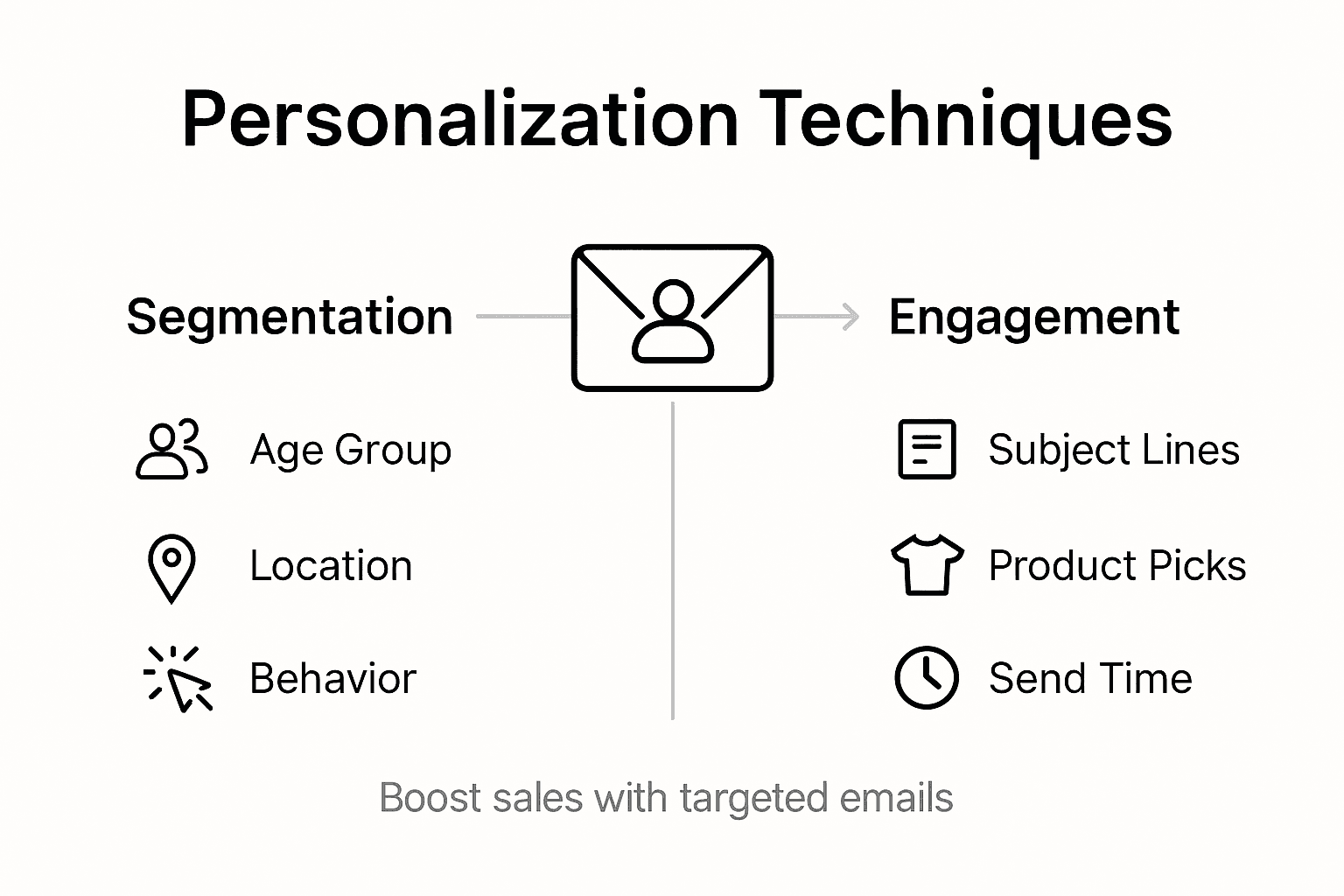
Moreover, sophisticated personalization techniques now incorporate psychological profiling, such as cognitive versus affective message appeals. This means crafting email content that not only matches a customer’s demographic profile but also aligns with their emotional and cognitive processing styles. For instance, some customers respond better to rational, data-driven messaging, while others are more influenced by emotional narratives and storytelling. By understanding these nuanced preferences, businesses can design email communications that resonate more deeply and authentically with individual recipients.
Here’s a summary of primary email personalization techniques and their unique business impacts:
| Personalization Technique | Key Data Used | Business Impact |
|---|---|---|
| Demographic Segmentation | Age, gender, location | Broader message relevance |
| Behavioral Targeting | Purchase, browsing | Higher engagement rates |
| Predictive Personalization | Past actions, AI | Increased conversion accuracy |
| Psychological Profiling | Emotional, cognitive | Stronger customer connection |
Pro tip: Develop a comprehensive customer data collection strategy that captures both quantitative behavioral metrics and qualitative preference insights to enable more sophisticated personalization techniques.
How Personalization Drives Engagement and Sales
Personalized email marketing strategies transform traditional communication approaches by creating deeply resonant connections with individual customers. Unlike generic mass communications, personalized emails leverage sophisticated data analysis to craft messages that speak directly to each recipient’s unique preferences, behaviors, and emotional triggers. This targeted approach dramatically increases the likelihood of customer engagement and subsequent sales conversions.
The psychological impact of personalization cannot be overstated. When customers receive emails that feel specifically designed for them, they experience a sense of individual recognition that significantly enhances their connection with a brand. Research demonstrates that personalized marketing strategies directly contribute to improved customer satisfaction, loyalty, and long-term retention. By analyzing customer data points such as purchase history, browsing behavior, and demographic information, businesses can create email content that feels intuitive and relevant to each specific recipient.

Key engagement drivers in personalized email marketing include tailored subject lines, dynamically generated product recommendations, and precisely timed communications. These strategies work by reducing cognitive load for customers, presenting only the most relevant information at the most opportune moments. Small businesses can implement personalization techniques ranging from basic segmentation to advanced predictive modeling, each approach offering incrementally more sophisticated ways of connecting with potential customers and converting interest into sales.
Pro tip: Start by segmenting your email list into at least 3-5 distinct groups and create specific content variations for each segment to immediately improve engagement rates.
Automation in Personalized Email Campaigns
Marketing automation represents a transformative approach to email communication, enabling businesses to create sophisticated, personalized interactions at scale. Automation technologies help marketers develop behavior-based trigger systems that deliver precisely timed and contextually relevant messages without requiring constant manual intervention.
The core strength of automated personalized email campaigns lies in their ability to respond dynamically to individual customer behaviors. Advanced automation tools can track specific actions like website visits, product views, abandoned cart moments, and previous purchase histories to generate highly targeted email sequences. For instance, an automated system might send a follow-up email with complementary product recommendations immediately after a customer completes a purchase, or trigger a re-engagement campaign for customers who haven’t interacted with the brand in several months.
Successful automation strategies typically incorporate multiple touchpoints and intelligent segmentation mechanisms. By creating complex logic trees that respond to specific customer interactions, businesses can craft email journeys that feel individually curated rather than mass-produced. These sophisticated workflows allow even small marketing teams to manage intricate communication strategies that would be impossible to execute manually, ensuring each customer receives communication that feels personal, timely, and relevant to their specific needs and interests.
Compare manual and automated personalized email campaigns:
| Approach | Scalability | Personalization Depth | Resource Requirement |
|---|---|---|---|
| Manual | Limited, time consuming | Basic to moderate | High human effort |
| Automated | Large scale, efficient | Advanced, dynamic | Streamlined, fewer staff |
Pro tip: Map out your customer journey and identify 3-5 key behavioral triggers that can automatically initiate personalized email communications to maximize engagement.
Common Pitfalls and Best Practices
Email marketing personalization requires a delicate balance between customization and customer comfort, with numerous potential pitfalls that can undermine even the most well-intentioned marketing efforts. Businesses must navigate complex terrain where data-driven insights intersect with customer privacy and communication preferences, understanding that overly aggressive personalization can quickly transform from helpful to invasive.
One of the most significant risks in personalized email marketing is the potential for privacy breaches and inappropriate data usage. Successful strategies demand meticulous attention to transparency, ensuring customers understand how their data is collected, used, and protected. This means implementing clear opt-in processes, providing straightforward privacy policies, and giving recipients granular control over their communication preferences. Small businesses must recognize that trust is fragile and can be easily eroded by perceived manipulation or excessive data intrusion.
Best practices in personalized email marketing center on creating genuinely valuable, relevant experiences that respect individual boundaries. This involves developing sophisticated segmentation strategies that go beyond basic demographic information, incorporating behavioral data, purchase history, and engagement patterns. Successful marketers understand that personalization is not about bombarding customers with information, but about delivering precisely timed, contextually appropriate messages that feel helpful rather than intrusive. Companies should continually refine their approach, using customer feedback and engagement metrics to adjust their communication strategies and maintain a human, empathetic approach to digital marketing.
Pro tip: Conduct a quarterly audit of your email personalization strategies, reviewing customer feedback, unsubscribe rates, and engagement metrics to ensure your approach remains respectful and effective.
Unlock the Power of Personalized Email Marketing to Grow Your Sales
The challenge many businesses face is turning vast amounts of customer data into meaningful, personalized email campaigns that truly engage recipients and drive sales growth. This article highlights the importance of using behavioral targeting, predictive personalization, and segmentation to reduce cognitive load and build stronger emotional connections with your audience. If you want to move beyond generic messages and start sending emails that feel like one-to-one conversations your solution lies in automation combined with smart personalization.
At emailedgar.com, we understand these pain points and provide a comprehensive digital marketing platform designed to help you build and maintain your email list while automating personalized campaigns that act as a silent sales machine working for you 24/7. Whether you are new to segmentation or ready for advanced predictive modeling our coaching resources and tools guide you step-by-step to achieve higher engagement and increased conversion rates. Discover how you can implement proven email marketing strategies informed by your customers’ unique behaviors and preferences.
Ready to take control of your email marketing results and grow your sales with powerful personalization and automation?
Explore the proven strategies at emailedgar.com now and start transforming your email campaigns into revenue-driving conversations today. Don’t wait to build the deeper customer connections that tomorrow’s successful businesses rely on. Learn more and get started with personalized email marketing that actually works.
Frequently Asked Questions
What are the benefits of personalizing email marketing?
Personalizing email marketing leads to higher engagement rates, improved customer satisfaction, and increased sales conversions. By crafting tailored messages, businesses can connect more effectively with their audience, enhancing overall retention.
How can I segment my email list for personalized marketing?
You can segment your email list based on criteria such as past purchase history, demographics, geographic location, and engagement patterns. This helps to create targeted messages for each group, making the communication feel more individualized.
What techniques are most effective for email personalization?
Key personalization techniques include demographic segmentation, behavioral targeting, predictive personalization, and psychological profiling. Each technique uses different data types to tailor messages that resonate with individual recipients based on their preferences and behaviors.
How does automation help in personalizing email campaigns?
Automation allows businesses to send personalized emails at scale by responding to customer behaviors in real-time. It simplifies the process of managing multiple touchpoints and ensures timely communication without requiring constant manual effort.
Recommended
- Will Email Marketing Make Me Any Sales? – EmailEdgar
- Top Mistakes to Avoid in Email Copywriting – EmailEdgar
- Email Marketing Trends to Watch in 2024 – EmailEdgar
- Email Marketing Headlines – How To Get Customers Clicking – EmailEdgar
- Top 10 Marketing Problems For PT, HIT & Strength Studios
- 7 Key Content Personalization Trends for Digital Marketers