

Bold goals and precise audience targeting are the backbone of every successful American email marketing campaign. For small business owners and digital marketers, the challenge lies in knowing exactly who you want to reach and what you want each automated email sequence to accomplish. With over 80 percent of American shoppers preferring personalized communication, mapping out specific goals and customer personas becomes the first crucial step toward driving sales and building strong engagement.
Table of Contents
- Step 1: Define Goals And Target Audiences
- Step 2: Build And Segment Your Email List
- Step 3: Design Compelling Automated Sequences
- Step 4: Test And Optimize Key Campaign Elements
- Step 5: Analyze Results And Improve Continuously
Quick Summary
| Key Point | Explanation |
|---|---|
| 1. Define Specific Email Goals | Clearly outline what you want to achieve, such as increasing sales or driving traffic, to guide your strategies. |
| 2. Build a Targeted Email List | Focus on quality contacts by using effective opt-in strategies and segmenting based on relevant characteristics. |
| 3. Create Engaging Automated Sequences | Develop email workflows that respond to subscriber behaviors, enhancing personal connection and engagement. |
| 4. Implement A/B Testing | Regularly test elements like subject lines and content to identify what drives better engagement and conversions. |
| 5. Continuously Analyze and Improve | Use performance metrics to gain insights, allowing you to refine your email marketing strategies consistently. |
Step 1: Define goals and target audiences
Successful email campaigns start with laser-focused goals and understanding who you are actually talking to. Your mission here is to build a crystal-clear picture of your ideal customer and precisely what you want to achieve through your email marketing efforts.
Begin by breaking down your campaign objectives into specific, measurable outcomes. Are you looking to increase product sales, drive website traffic, nurture leads, or boost customer retention? Each goal demands a different strategic approach. Understanding how to identify your target audience requires deep research into your customer demographics, behaviors, and pain points.
To map out your target audience effectively, create detailed customer personas that go beyond basic demographics. Consider factors like age, income, professional role, purchasing behaviors, and specific challenges your product or service solves. Collect data through surveys, website analytics, and customer feedback to develop nuanced profiles that will guide your email messaging and segmentation strategies.
Pro tip: Create a one-page summary document for each target persona that includes their goals, obstacles, and preferred communication style. This snapshot will become your north star when crafting personalized email content that truly resonates.
Here’s a summary of typical goals in email marketing and how they influence strategy:
| Goal Type | Key Focus Areas | Example Tactics |
|---|---|---|
| Increase Sales | Promotions, product launches | Flash sales, discounts |
| Drive Traffic | Website visits, blog readers | Content highlights, links |
| Nurture Leads | Trust-building, education | Drip campaigns, case studies |
| Retain Customers | Loyalty, repeat purchases | Re-engagement, rewards |
Step 2: Build and segment your email list
Building a high-quality email list is like constructing a precision instrument for your marketing strategy. Your goal is to create a targeted collection of contacts who are genuinely interested in what you offer, ensuring maximum engagement and conversion potential.

Start by implementing multiple opt-in strategies across your digital platforms. Website pop-ups, landing pages, social media sign-up forms, and content downloads can help you organically grow your list. Focus on quality over quantity. Effective email segmentation strategies allow you to break down your audience into meaningful groups based on specific characteristics like demographics, purchase history, engagement levels, and behavioral patterns.
To create meaningful segments, collect comprehensive data through signup forms, tracking customer interactions, and analyzing purchase behaviors. Consider segmenting your list by factors such as age group, industry, past purchase frequency, geographic location, and specific interests. This granular approach enables you to craft personalized messages that speak directly to each group’s unique needs and preferences.
Pro tip: Implement a regular email list hygiene process by removing inactive subscribers every six months. This keeps your list fresh, improves deliverability rates, and ensures your metrics reflect genuinely engaged contacts.
See how common segments differ in email marketing:
| Segment Type | Typical Criteria | Content Approach |
|---|---|---|
| Demographic | Age, gender, location | Age-relevant offers |
| Behavioral | Past purchases, engagement | Personalized product picks |
| Interest-based | Preferences, interaction type | Targeted recommendations |
| Lifecycle Stage | New vs. loyal subscriber | Welcome vs. loyalty messaging |
Step 3: Design compelling automated sequences
Automated email sequences are the silent powerhouses of your marketing strategy transforming casual contacts into committed customers. Your mission is to create intelligent email workflows that deliver the right message to the right person at precisely the right moment.
Advanced email marketing automation techniques enable you to craft intricate communication pathways that respond dynamically to subscriber behaviors. Start by mapping out distinct customer journeys based on specific triggers like website interactions, purchase history, or engagement levels. Consider developing sequences such as welcome series for new subscribers, onboarding workflows for recent customers, re-engagement campaigns for inactive contacts, and nurture sequences for leads at different stages of your sales funnel.
Each automated sequence should tell a cohesive story with carefully timed and personalized messages. Space your emails strategically to maintain interest without overwhelming subscribers. Use progressive content that builds value with each interaction moving subscribers closer to your desired conversion goal. Incorporate personalization elements like first names, relevant product recommendations, and content tailored to their specific interests or previous interactions.
Pro tip: Implement a ‘cooling off’ period between emails in your automated sequences to prevent subscriber fatigue. Track engagement metrics closely and be prepared to adjust your timing and content based on real-world performance data.
Step 4: Test and optimize key campaign elements
Successful email marketing isn’t about guesswork it’s about strategic refinement. Your goal is to continuously improve your email campaigns by systematically testing and analyzing key performance elements that drive conversions.
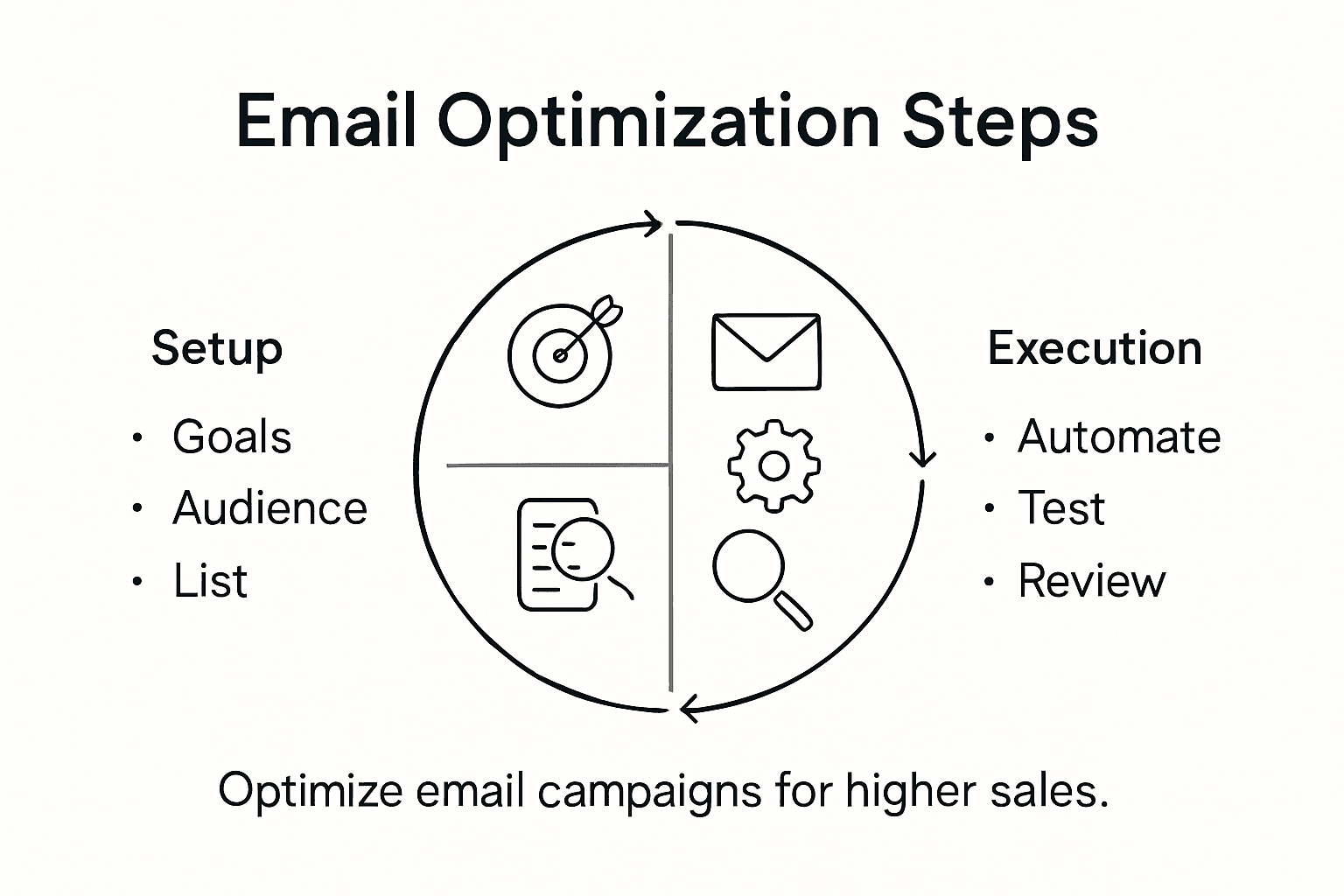
How to measure the success of your email campaigns starts with implementing a robust A/B testing strategy. Focus on experimenting with critical components like subject lines, email content, send times, call to action buttons, and visual design. Select one variable at a time to test so you can accurately identify what truly impacts your audience’s engagement and conversion rates. Track metrics such as open rates, click through rates, conversion rates, and unsubscribe rates to understand the real impact of your experiments.
Develop a consistent testing schedule where you methodically analyze and iterate your email campaign elements. Create controlled experiments with statistically significant sample sizes to ensure your findings are reliable. Segment your email list strategically so you can compare performance across different audience groups. Remember that optimization is an ongoing process small incremental improvements can compound into substantial gains over time.
Pro tip: Create a testing calendar that outlines your planned experiments and allocates specific timeframes for each test. Document your findings meticulously and use insights to inform future campaign strategies.
Step 5: Analyze results and improve continuously
Unlocking the true potential of your email marketing requires more than just sending messages it demands a strategic approach to understanding and interpreting performance data. Your mission is to transform raw metrics into actionable insights that drive meaningful improvements.
Advanced strategies for analyzing email campaign data begin with establishing a comprehensive dashboard of key performance indicators. Focus on tracking critical metrics like open rates, click through rates, conversion rates, list growth, subscriber engagement, and revenue generated per campaign. Use statistical analysis to identify patterns and trends that reveal what resonates with your audience. Look beyond surface level numbers to understand the deeper story your data is telling about customer behavior and preferences.
Develop a systematic review process where you conduct regular deep dive analyses into your email campaign performance. Create comparative reports that track performance over time, allowing you to see incremental improvements and identify areas needing adjustment. Implement a continuous feedback loop where insights from one campaign directly inform the strategy of the next. Consider leveraging advanced analytical techniques like segmentation analysis and predictive modeling to gain deeper understanding of your audience behavior.
Pro tip: Schedule quarterly comprehensive performance reviews where you not only analyze metrics but also gather qualitative feedback from your team and customers. Use these insights to recalibrate your email marketing strategy and maintain a dynamic approach to improvement.
Master Email Campaign Optimization with Proven Automation Strategies
Struggling to transform your email list into a powerful sales engine is a common challenge highlighted in the Email Campaign Optimization Guide for Higher Sales Results. This article clearly shows how pinpointing your target audience, segmenting your list, and crafting automated workflows are key to driving higher revenue while avoiding guesswork. If improving click through rates and conversions feels like a puzzle it is time to embrace automation that works consistently behind the scenes.
At emailedgar.com, we understand the frustration of building email campaigns without clear insights or tested workflows. Our platform provides tailored coaching and tools designed to help you design compelling automated email sequences and optimize every campaign element. You will learn how to nurture leads with precision, re-engage inactive subscribers, and scale your efforts for maximum impact.
Discover how to turn your email marketing into a silent sales machine that performs 24/7.
Boost your results today with personalized guidance on list segmentation, testing, and continuous improvement at emailedgar.com.
Ready to stop hoping and start growing your sales with proven email automation techniques? Visit emailedgar.com now to access expert resources, actionable strategies, and support that will elevate your email marketing success.
Frequently Asked Questions
How can I define my email campaign goals for higher sales results?
To define your email campaign goals, break them down into specific measurable outcomes like increasing product sales, driving website traffic, or nurturing leads. Start by identifying what you want to achieve and tailor your strategy accordingly; for instance, focus on promotional content if your goal is to boost sales.
What steps should I take to effectively segment my email list?
To effectively segment your email list, collect comprehensive data from signup forms and customer interactions. Divide your audience based on criteria such as demographics, purchase history, and engagement levels to craft personalized messages that resonate with each group.
What types of automated email sequences should I create for my campaign?
Create automated email sequences that match your customer journey, such as welcome series for new subscribers and re-engagement campaigns for inactive contacts. Each sequence should consist of timed, personalized messages that guide subscribers toward conversion, ensuring they feel valued throughout their interaction.
How can I measure the success of my email campaigns?
You can measure the success of your email campaigns by tracking key metrics such as open rates, click-through rates, and conversion rates. Set up a systematic review process to analyze these metrics regularly, allowing you to identify trends and make data-driven adjustments to improve future campaigns.
What should I focus on when testing elements of my email campaigns?
When testing elements of your email campaigns, focus on one variable at a time, such as subject lines or content layout. This approach will help you accurately determine what impacts engagement; for example, try testing subject lines to potentially increase your open rates by 10-15%.